Dumbbells Wholesale: Minimum Orders, Pricing, and Quality Risks
Time
Click Count
Dumbbells Wholesale: Minimum Orders, Pricing, and Quality Risks
For procurement teams evaluating dumbbellswholesale opportunities, the real challenge goes beyond low unit prices.
Minimum order quantities, freight costs, material consistency, and hidden quality risks can quickly change the real economics of a deal.
This guide explains how to compare suppliers, control sourcing risk, and negotiate smarter terms before placing large dumbbellswholesale orders.
Why dumbbellswholesale decisions are more complex than they look
At first glance, dumbbellswholesale looks simple.
You compare unit prices, choose a factory, and place the order.
In practice, the buying decision is broader.
Dumbbells are heavy, material-sensitive, and highly exposed to handling damage.
That means pricing, packaging, and quality control all matter as much as the quote itself.
A supplier with a lower ex-works price may still create a higher landed cost.
This is especially true when freight, defect rates, rework, and claims handling are poorly defined.
The main cost drivers behind dumbbellswholesale
Material choice is the first driver.
Cast iron, rubber-coated, urethane-coated, and neoprene styles carry very different cost structures.
The second driver is weight tolerance.
Tighter tolerance usually means better process control, but also a higher production cost.
The third driver is finish quality.
Coating adhesion, odor level, corrosion resistance, and logo durability affect both user experience and return rates.
How minimum order quantities shape your sourcing plan
MOQ is often the first negotiation barrier in dumbbellswholesale.
Factories set MOQs to protect mold setup, coating runs, packaging labor, and container efficiency.
However, not all MOQ structures mean the same thing.
- Per SKU MOQ: minimum quantity for each weight or model.
- Per order MOQ: total quantity across mixed weights.
- Per color MOQ: common with neoprene or custom branding.
- Per packaging MOQ: tied to box type, labels, or retail display packs.
This distinction matters when demand is still uncertain.
A mixed-weight order can reduce inventory pressure and improve cash flow.
On the other hand, custom packaging can quietly push the real MOQ much higher than expected.
Questions to ask before accepting MOQ terms
- Can weights be mixed within one dumbbellswholesale order?
- Does the MOQ change for standard versus custom logos?
- Can trial orders convert into repeat-order pricing later?
- Is the MOQ based on units, sets, pallets, or container space?
- What extra fees appear if volume stays below the target run size?
These questions help separate a flexible partner from a factory simply protecting its own production schedule.
How to read dumbbellswholesale pricing beyond the unit quote
Many buyers focus too heavily on the price per kilogram or price per pair.
That number matters, but it is rarely enough.
A better approach is to compare total landed cost by supplier scenario.
From a procurement view, dumbbellswholesale pricing should be modeled in three layers.
- Quoted manufacturing cost.
- Logistics and compliance cost.
- Risk-adjusted after-sales cost.
This framework makes low-price offers easier to challenge during supplier review.
Pricing signals that deserve extra caution
- A quote that is far below market without a material explanation.
- No written tolerance standard for weight accuracy.
- Packaging excluded from the initial dumbbellswholesale quote.
- Vague statements about coating quality or smell control.
- No clear answer on rust protection during ocean transit.
The most common quality risks in dumbbellswholesale
Quality failures in dumbbellswholesale are usually predictable.
The problem is that many buyers catch them too late.
Most issues appear in five areas.
1. Weight inconsistency
Actual weight may drift outside the accepted tolerance.
This damages product credibility and creates complaints in both retail and commercial gym channels.
2. Coating defects
Rubber, neoprene, or urethane layers may crack, peel, or show color variation.
In actual business, this is often linked to weak raw material control or rushed curing time.
3. Handle and grip problems
Knurling can be too sharp, too smooth, or uneven across batches.
That affects comfort, safety, and brand perception.
4. Corrosion and odor
Moisture protection failures can cause rust during shipping or warehouse storage.
Strong chemical odor can also trigger customer rejection, especially in indoor fitness settings.
5. Packaging breakdown
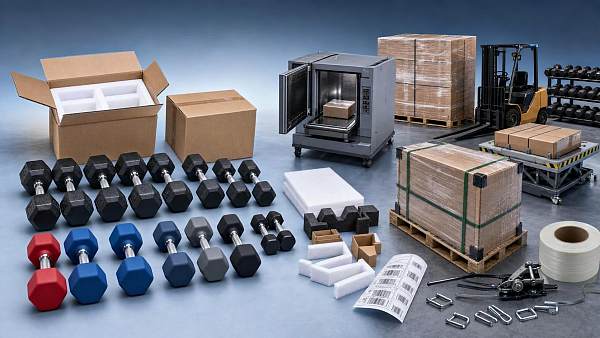
Heavy dumbbells can burst cartons, deform inserts, or damage pallet stability.
This risk is easy to underestimate during dumbbellswholesale evaluation.
How to reduce dumbbellswholesale risk before mass production
The best time to control risk is before the purchase order is finalized.
A stronger sourcing process usually costs less than post-shipment correction.
Build a clear technical specification sheet
Do not rely on catalog descriptions alone.
Define weight tolerance, dimensions, coating type, hardness, odor limits, logo method, and packaging requirements.
This creates a measurable base for dumbbellswholesale inspection and claim resolution.
Request pre-production samples from the actual line
A polished showroom sample is not enough.
Ask for samples that reflect real production methods, packaging, and finishing conditions.
That reduces surprises when scaling dumbbellswholesale volume.
Use third-party inspections at the right stages
- Pre-production inspection for raw material and process readiness.
- During-production inspection for weight consistency and finish stability.
- Pre-shipment inspection for packaging, labeling, and random function checks.
For higher-value dumbbellswholesale programs, inspection timing matters as much as inspection presence.
Negotiation strategies that improve total purchasing value
Better negotiation is not only about asking for a cheaper price.
It is about improving the full economics of the dumbbellswholesale transaction.
- Negotiate mixed-SKU MOQ instead of a flat reduction request.
- Ask for packaging upgrades before asking for unit-price cuts.
- Lock weight tolerance and coating standards into the purchase agreement.
- Tie repeat-order pricing to approved sample performance.
- Define compensation rules for defect rates and transit damage.
From recent market shifts, smarter buyers are prioritizing controllable terms over headline discounts.
That is often the better path to stable dumbbellswholesale margins.
A practical checklist for final supplier selection
Before approving a dumbbellswholesale supplier, run a simple final review.
- Confirm MOQ logic for SKUs, branding, and packaging.
- Compare landed cost, not just factory quote.
- Review sample consistency against written specifications.
- Check defect handling, claim policy, and response time.
- Validate carton strength and pallet loading plan.
- Approve inspection checkpoints before production starts.
This checklist keeps the dumbbellswholesale decision grounded in measurable business outcomes.
When MOQ, pricing, and quality controls are evaluated together, sourcing becomes more predictable, margins become more defendable, and supplier selection becomes far easier to justify internally.
Recommended News
 Jul 27, 2026How to Evaluate Automated Inspection Systems for PackagingAutomated Inspection Systems for packaging: learn how to compare accuracy, speed, integration, and compliance to choose a reliable solution that cuts rejects and protects product quality.
 Jul 21, 2026Automation Inspection Solutions Europe: Cost, Compliance, and Vendor FitAutomation Inspection Solutions Europe: compare total cost, EU compliance, and vendor fit to reduce sourcing risk, improve quality performance, and choose scalable inspection systems with confidence.
 Jul 17, 2026How to Evaluate Automated Precision Inspection Equipment Accuracy and ROIAutomated precision inspection equipment accuracy and ROI depend on more than specs. Learn how to benchmark performance, control hidden costs, and choose a system that delivers reliable quality.
 Jul 14, 2026How to Compare an Automated Inspection Systems Manufacturer for Line AccuracyAutomated Inspection Systems manufacturer comparison starts with real line accuracy. Learn how to assess validation, integration, traceability, and support before you buy.
 Jul 13, 2026Machine Vision Inspection Systems in North America: 2026 Supplier and Adoption TrendsMachine vision inspection systems North America trends for 2026: compare suppliers, AI adoption, and key buying criteria shaping quality, traceability, and smarter manufacturing decisions.
 Jul 08, 2026Semiconductor Chips Inspection: Common Defect Risks and Detection LimitsSemiconductor chips inspection explained: learn the most common defect risks, true detection limits, and practical ways to improve yield, reliability, and quality control.
![]() Jul 07, 2026Quality Inspection Equipment for High-Mix Production: What Works Best?Quality inspection equipment for high-mix production: learn how to match vision, metrology, and traceability tools to changeovers, tolerances, and compliance needs.
Jul 07, 2026Quality Inspection Equipment for High-Mix Production: What Works Best?Quality inspection equipment for high-mix production: learn how to match vision, metrology, and traceability tools to changeovers, tolerances, and compliance needs. Jul 06, 2026Inline Vision Inspection Systems: Key Checks Before SelectionVision Inspection Systems inline: learn the key checks before selection, from defect detection and line speed to traceability, AI governance, and long-term reliability.
 Jun 28, 2026Zero Defect Manufacturing: Vision Inspection Setup GuideHow to Achieve Zero Defect Manufacturing with Vision Inspection: learn a practical setup guide covering optics, lighting, AI, traceability, and process control to cut defects fast.
 Jun 25, 2026Dumbbells Wholesale: Minimum Orders, Pricing, and Quality Risksdumbbellswholesale guide covering MOQs, pricing, freight, and quality risks. Learn how to compare suppliers, cut sourcing costs, and negotiate smarter wholesale terms.
 Jun 22, 2026AI for Business: Where Automation Cuts Cost FirstAI for business cuts costs fastest in inspection, testing, and reporting. Learn where automation delivers quick ROI, fewer errors, and measurable operational savings.
 Jun 20, 2026Intimate Apparel Sizing Mistakes That Hurt Fit QualityIntimate apparel sizing mistakes can quietly damage fit quality, raise returns, and disrupt production. Learn the key risks, inspection points, and control methods that improve consistency.
 Jun 19, 2026Electronic Components Shortlist: Reliability Risks to Check FirstElectronic components should be screened for reliability before price or specs. Learn the first risks to check—drift, heat, noise, and moisture—to build a safer shortlist.
 Jun 17, 2026AI Agents in 2026: Use Cases, Limits, and ROI SignalsAI agents in 2026 are shifting from hype to measurable execution. Explore real use cases, limits, and ROI signals to see where governed adoption drives faster decisions and operational value.
 Jun 16, 2026How a Spark Plugs Factory Controls Defect RatesSpark plugs factory defect control explained: see how leading plants cut failures with in-line inspection, metrology, traceability, and fast corrective action.
 Jun 15, 2026Die Casting Defects: Causes, Fixes, and Quality ChecksDie casting defects explained: learn the main causes, practical fixes, and quality checks to reduce porosity, flash, and misruns while improving process stability and part reliability.
 Jun 11, 2026How to Evaluate a Car Batteries Factory for Output and Quality StabilityCar batteries factory evaluation goes beyond price—learn how to verify output, quality stability, traceability, and process control before choosing a reliable supplier.
 May 23, 2026When an Automated Inspection Cell OEM Pays OffAutomated inspection cell OEM ROI explained: learn when standard automation beats custom builds on cost, precision, integration, and scalability for faster quality gains.
 May 22, 2026High Accuracy Quality Control Systems: When the Extra Cost Pays OffHigh Accuracy Quality Control Systems deliver ROI when defect costs, compliance risk, and rework are high. Learn when the extra investment protects margins and pays off.
 May 22, 2026Industrial Benchmarking for Quality Control Systems That Actually MattersIndustrial Benchmarking for Quality Control Systems that goes beyond specs—learn how to compare uncertainty, traceability, uptime, and integration to improve yield, compliance, and decisions.
 May 20, 2026Smart Inspection Technology Alerts Worth Acting OnSmart inspection technology alerts help after-sales teams spot calibration drift, vision issues, and data faults early—reduce downtime, improve accuracy, and act faster with confidence.
 May 20, 2026AI Driven Inspection: When Defect Alerts Reduce ReworkAI Driven Inspection helps manufacturers catch defects earlier, cut rework, improve traceability, and speed corrective action—discover how smarter alerts protect yield and quality.
 May 16, 2026Surface Roughness Tester Wholesale: Common Spec Gaps That Cause ReworkSurface roughness tester wholesale buyers: discover the hidden spec gaps in cutoff, probes, standards, and reporting that trigger rework—and how to choose the right fit first.
 May 14, 2026Vision Inspection Systems for Zero Defect Manufacturing: Key Setup MistakesVision Inspection Systems for Zero Defect Manufacturing: avoid setup mistakes in lighting, calibration, optics, and recipes to reduce false rejects and improve production reliability.