Workspace Design Trends 2026: Layouts That Improve Focus
Time
Click Count
Workspace design is shifting from style to measurable focus
In 2026, workspace design is no longer judged by visual novelty alone. The sharper question is whether a layout protects concentration during hybrid work and supports reliable performance.
That change matters across industries. Knowledge work, technical collaboration, compliance review, and engineering analysis all depend on fewer interruptions and better control of attention.
The strongest layouts now connect space planning with business signals. These include task completion rates, meeting overload, acoustic stress, team coordination, and retention pressure.
For organizations operating in precision-driven environments, this is especially relevant. In settings shaped by measurement discipline, workspace design increasingly mirrors the same logic used in operational benchmarking.
That is why the conversation has moved beyond open-plan versus private office. The real issue is how layouts guide focus, switching costs, and decision quality across the day.
The clearest signal is the decline of one-size-fits-all layouts
Recent workspace design decisions show a clear break from uniform floor plans. Large, undifferentiated seating areas are losing favor because they amplify noise, visual motion, and shallow interaction.
In their place, organizations are building mixed-focus environments. These layouts separate deep work, fast coordination, confidential discussion, and social recharge without turning offices into rigid zones.
This shift reflects a simple reality. Employees no longer come on-site for the same reasons every day, so workspace design must support changing intensity levels rather than a single work pattern.
More noticeable still is the rise of task-based occupancy planning. Instead of counting desks, planners are mapping what kind of cognitive effort each team performs and when distraction becomes costly.
What is pushing this change
- Hybrid attendance creates uneven demand across days, teams, and project phases.
- Cognitive work has become more interruption-sensitive, especially in analysis-heavy roles.
- Real estate budgets now require layouts to justify performance, not just capacity.
- Well-being metrics increasingly include acoustic comfort, movement quality, and sensory load.
- Digital collaboration tools reduce the need for constant physical proximity.
Together, these pressures are reshaping workspace design into a business system. Space is being treated less as a fixed asset and more as a performance environment.
Focus-first layouts are becoming the benchmark
The most effective workspace design trend for 2026 is the focus-first layout. This approach does not eliminate collaboration. It reduces the friction that comes from unmanaged overlap between focused and social activity.
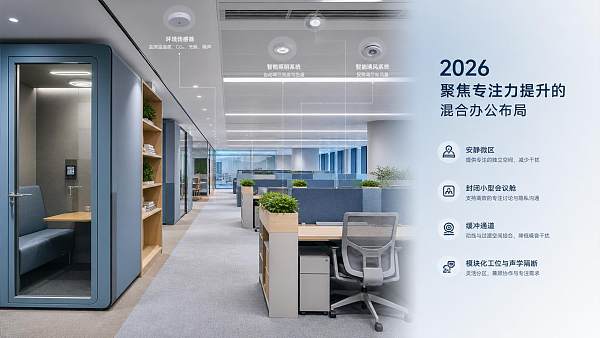
In practical terms, that means smaller team neighborhoods, more enclosed quiet rooms, clearer circulation paths, and tighter rules around noisy functions. It also means fewer status-driven seat allocations.
The best examples borrow from high-performance operational environments. Measurement labs, inspection centers, and mission-critical control rooms have long understood that layout affects error rates and mental fatigue.
The same principle now appears in corporate workspace design. When attention is treated as a finite resource, floor plans start to look more intentional and less decorative.
What makes this more than design fashion is the measurement layer behind it. Better workspace design increasingly depends on occupancy sensing, environmental monitoring, and post-occupancy evidence.
Why sensory data is entering the workspace design conversation
A notable 2026 development is the convergence of workspace design with sensing and benchmarking disciplines. Organizations want proof that a layout reduces distraction instead of simply appearing more flexible.
This is where a measurement-oriented perspective becomes useful. G-IMS has built its authority around turning sensor performance and technical standards into actionable intelligence, and that logic increasingly fits workplace planning.
Environmental sensors, non-contact monitoring, and calibrated acoustic analysis can now show how specific zones perform. Light variability, air quality swings, crowding peaks, and reverberation patterns are no longer hidden variables.
That matters because poor workspace design often fails quietly. Attention erosion, decision fatigue, and fragmented collaboration do not always appear in a budget line, yet they accumulate across teams.
From that perspective, the next phase of workspace design looks more evidence-led. Layout choices are starting to resemble controlled operational adjustments, not aesthetic assumptions.
Signals worth tracking
- Noise complaints clustered by zone and time window.
- Underused collaboration areas despite high booking demand elsewhere.
- Teams extending focused work into off-hours to avoid daytime interruption.
- Uneven occupancy around windows, quiet corners, or enclosed spaces.
- Air, temperature, or lighting conditions drifting outside comfortable ranges.
The impact reaches far beyond employee comfort
Better workspace design is often discussed as a well-being topic, but the business implications are broader. Layout quality influences cycle time, review accuracy, meeting behavior, and how quickly complex issues are resolved.
In technical and regulated environments, the stakes are even higher. Work involving documentation, analysis, verification, or precision communication suffers when layouts encourage constant interruption.
That is why focus-friendly workspace design increasingly aligns with institutional rigor. Organizations used to benchmarking tools, tolerances, and compliance thresholds are also more likely to expect measurable workplace outcomes.
The effect also reaches culture. When people can predict where to collaborate, where to think, and where to recover, the office becomes easier to use. Friction drops without requiring more policy.
Where the difference becomes visible
Project teams see fewer context-switching losses. Review-intensive functions gain cleaner discussion environments. Cross-functional groups can meet quickly without disrupting adjacent work.
In hybrid settings, the office also regains strategic purpose. People come in for activities that benefit from proximity, while focused tasks are supported by spaces designed to protect concentration.
What to prioritize before redesign decisions harden
Not every organization needs a dramatic rebuild. In many cases, the next improvement in workspace design comes from better zoning, better sensing, and clearer matching between tasks and places.
A useful starting point is to map work modes rather than departments. Focus work, review work, spontaneous alignment, confidential discussion, and decompression all create different spatial demands.
It also helps to separate visible complaints from hidden losses. Employees may mention noise, but the underlying problem could be circulation routes, poor enclosure strategy, or unstable environmental conditions.
The more mature approach is to test before scaling. Pilot zones, occupancy analytics, acoustic checks, and comfort measurements can reveal whether a workspace design concept actually improves focus.
- Audit distraction sources by task type, not by floor alone.
- Measure environmental quality before and after layout changes.
- Prioritize enclosed quiet capacity over symbolic open collaboration space.
- Use sensor data to validate assumptions about occupancy and comfort.
- Review layouts against performance indicators, not design trends alone.
The next move is disciplined experimentation
The most durable workspace design trends in 2026 are practical, not theatrical. They recognize that attention has become a scarce resource and that layout decisions can either protect it or drain it.
The strongest organizations will not treat workspace design as a branding project. They will treat it as an operating variable, tested against focus, comfort, and measurable work quality.
That is where the broader logic of intelligent measurement becomes relevant. Evidence-led environments, whether in industrial inspection or office planning, tend to outperform assumption-led ones over time.
A sensible next step is to review where concentration fails today, compare layout options against actual work modes, and build a staged plan for workspace design improvements that can be measured.
The office of 2026 does not need to be louder, denser, or more decorative. It needs to be clearer about how focus happens and disciplined enough to design for it.
Recommended News
 Aug 10, 2026Next-Gen Wireless Charging for Smartphones: What Improves Speed, Heat, and Compatibility?Next-gen wireless charging for smartphones is improving speed, reducing heat, and boosting compatibility. Learn what Qi2, alignment, and thermal control mean before you buy.
 Jul 04, 2026Electronics Measurement Solutions Cost: What Drives Total Ownership in 2026Electronics Measurement Solutions cost in 2026 goes beyond unit price. Learn what drives total ownership, from calibration and software to downtime, upgrades, and long-term ROI.
 Jun 16, 2026Relay Modules Troubleshooting for Unstable Signalsrelaymodules troubleshooting guide for unstable signals: identify power, wiring, EMI, and contact faults fast to reduce downtime, restore stability, and prevent repeat failures.
 Jun 15, 2026Automated Trade Platform Trends to Watch in 2026Automated trade platform trends for 2026 reveal how smarter compliance, supplier intelligence, AI exception detection, and technical benchmarking can improve sourcing decisions worldwide.
 Jun 07, 2026Workspace Design Trends 2026: Layouts That Improve FocusWorkspace design trends for 2026 focus on layouts that reduce distractions, support hybrid work, and improve performance. Discover evidence-led ideas that boost focus and productivity.
 Jun 06, 2026Smart Hotel Price Models: What Affects Total Cost?Smart hotel price explained: discover what really affects total cost, from devices and integration to compliance, maintenance, and long-term ROI before you compare quotes.
 May 31, 20263D Scanning Mesh Quality Benchmarks That Actually Affect Accuracy3d scanning mesh quality benchmarks that reveal accuracy risks in density, noise, holes, edges, and repeatability—helping teams trust scan data before critical decisions.
 May 21, 2026Electrical Test Equipment Supplier Checklist for Lower Downtime RiskElectrical Test equipment supplier checklist for lower downtime risk: compare calibration, loaner support, response speed, and lifecycle service to protect uptime and buy with confidence.
 May 21, 2026Spectrum Analyzers for RF Testing: Key Specs That Impact Test ConfidenceSpectrum Analyzers for RF testing: learn which specs truly affect confidence—DANL, phase noise, RBW, dynamic range, and accuracy—to choose smarter and trust every RF result.
 May 13, 2026How to Vet an Electrical Test Equipment SupplierElectrical Test equipment supplier selection affects accuracy, compliance, and uptime. Learn how to vet suppliers with practical criteria for traceability, service, and long-term value.
 May 03, 2026How to Compare an Electrical Test Equipment SupplierElectrical Test equipment supplier comparison starts with application fit. Learn how to evaluate accuracy, compliance, support, and delivery to reduce risk and choose with confidence.
 May 02, 2026High Frequency Measurement Errors That Distort Real ResultsHigh Frequency Measurement errors can quietly distort critical test results. Learn the main causes, reduce uncertainty, and make smarter validation and procurement decisions.
 Apr 24, 2026Why Spectrum Analyzers Miss Intermittent RF ProblemsSpectrum Analyzers for RF testing can miss intermittent faults. Learn how Electrical Test equipment, NIST Standards for calibration, and smarter capture methods improve RF troubleshooting.
 Apr 24, 2026Electrical Test Errors That Come From Fixture DesignElectrical Test errors often start in fixture design. Learn how Spectrum Analyzers, Industrial Sensors, IEEE Standards, and NIST Standards help improve accuracy, repeatability, and production confidence.