Smart Hotel Price Models: What Affects Total Cost?
Time
Click Count
Smart hotel price: why does the total cost vary so much?
When people search for smart hotel price, they often expect a simple number. In practice, the real figure depends on how intelligence is defined, measured, and maintained.
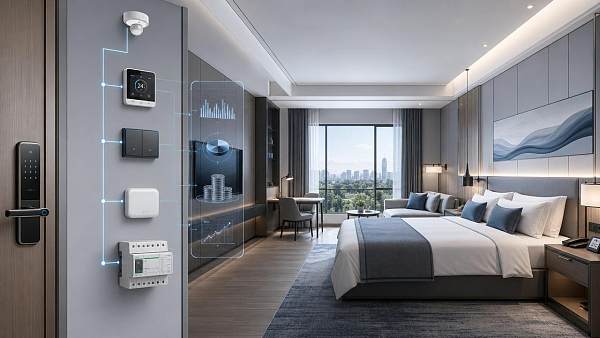
A smart room with app-based lighting is one thing. A fully connected hotel with occupancy sensing, energy optimization, access control, and predictive maintenance is another.
That gap explains why one proposal looks affordable at first, while another appears expensive but performs better over time.
A more useful way to assess smart hotel price is to look beyond hardware labels and ask what drives total cost across the full system lifecycle.
This is also where a measurement-driven view matters. In complex technical sectors, including hospitality automation, value comes from verified data quality, integration discipline, and operational reliability.
That logic aligns with the broader G-IMS approach: measurable performance should guide investment decisions, not marketing claims alone.
Is smart hotel price mainly about room devices and software licenses?
Not really. Devices and software are visible line items, but they rarely explain the full smart hotel price.
The larger cost picture usually includes integration work, network architecture, installation labor, commissioning, interoperability testing, cybersecurity settings, and post-launch support.
In many projects, integration costs rise faster than equipment costs. That happens when old building systems must connect with newer IoT platforms.
A hotel may already have HVAC controls, access systems, CCTV, fire safety hardware, and property management software. Making them exchange reliable data is rarely plug-and-play.
There is also a difference between buying features and buying measurable outcomes. A low headline smart hotel price may exclude calibration checks, uptime targets, or analytics quality validation.
That omission matters because sensor-driven automation is only as good as the signals it receives. If occupancy sensing is inaccurate, room conditioning and housekeeping workflows become less efficient.
So, the better question is not “How much is the kit?” but “What level of verified performance is included in the smart hotel price?”
A quick cost breakdown helps
This table shows why comparing quotes without scope matching often leads to poor conclusions.
Which technical factors have the biggest effect on smart hotel price?
Several technical variables shape smart hotel price, and some are easy to miss during early budgeting.
Sensor quality is one of the most important. Basic motion detection may be enough for simple lighting control. It is less suitable for precise occupancy-based energy decisions.
Accuracy affects automation confidence. Better sensors usually cost more, but they also reduce false triggers, comfort complaints, and energy waste.
Communication protocol is another factor. Open and widely supported protocols may reduce future lock-in. Proprietary ecosystems can simplify deployment, yet increase upgrade dependency.
Automation scope matters too. A project covering guestroom control only will have a lower smart hotel price than one linking rooms, back-of-house systems, utilities, and maintenance analytics.
Then comes data architecture. Real-time dashboards, edge processing, and cloud analytics each create different storage, bandwidth, and security requirements.
In technical benchmarking environments, such as those emphasized by G-IMS, system value is judged through traceable performance and standards-based verification.
Hospitality projects do not need laboratory-level metrology everywhere. Still, the same discipline applies: if measurement quality is weak, automation value becomes uncertain.
- Higher sensing precision tends to raise upfront smart hotel price.
- Better interoperability can reduce future expansion cost.
- More automation rules increase commissioning effort.
- Stronger analytics add long-term value, but also platform cost.
Why do installation, retrofitting, and compliance change the budget so much?
Because buildings are never identical, even when room counts look similar.
A new-build property can plan network paths, device placement, power supply, and platform interfaces from the start. That usually makes the smart hotel price easier to predict.
Retrofit projects are different. Existing walls, ceilings, control panels, and wiring routes often create hidden labor costs.
Operational disruption also has a cost. If installation must happen floor by floor, during occupancy, the schedule becomes slower and more expensive.
Compliance adds another layer. Data privacy controls, electrical safety, fire system separation, and cybersecurity practices may all require extra engineering work.
In regions with stricter audit expectations, documentation quality becomes part of the smart hotel price. Validation records, device certifications, and network security evidence are not paperwork afterthoughts.
This is where cross-industry thinking helps. G-IMS highlights how standards-based verification supports confidence in high-precision systems. Hospitality technology benefits from the same habit of documented performance.
When a vendor quote looks unusually low, it is worth checking whether commissioning, testing, and compliance support are included or deferred.
Can a higher smart hotel price still be the better investment?
Yes, if the added cost improves measurable outcomes instead of adding decorative features.
A higher smart hotel price may bring stronger device reliability, better energy control, fewer false service alerts, or cleaner data for operational decisions.
That difference becomes meaningful when evaluating total ownership cost over three to seven years, not just installation spend.
For example, cheaper room sensors may fail earlier or drift in performance. Replacements, troubleshooting, and guest disruption can erase the initial savings.
Likewise, a weak analytics layer may collect data without turning it into usable actions. In that case, the smart hotel price buys visibility but not operational improvement.
A practical evaluation should look at these questions:
- Does the system reduce avoidable energy consumption with credible measurement logic?
- Can it connect cleanly with existing property systems?
- Are maintenance intervals and update policies clearly defined?
- Is the data accurate enough to support automation decisions?
- Will expansion to more rooms or sites require major rework?
If the answer is yes to most of these, a higher smart hotel price may reflect lower risk and better lifecycle economics.
What mistakes lead to a misleading smart hotel price comparison?
The most common mistake is comparing proposals with different scopes and assuming they represent the same solution.
Another mistake is treating all sensors as equal. Two occupancy devices may look similar on paper, while delivering very different detection quality in real rooms.
Some evaluations also ignore data governance. If access logs, room controls, and behavioral data are collected, retention and protection rules affect the true smart hotel price.
There is also a tendency to underestimate maintenance. Batteries, firmware updates, recalibration, and gateway replacement can become recurring cost drivers.
A final issue is poor KPI definition. Without baseline metrics, it becomes hard to judge whether the smart hotel price delivers returns through energy savings, labor efficiency, or service quality.
A practical comparison checklist
How should the next evaluation step be structured?
Start by defining what the smart hotel price is expected to buy. That sounds obvious, but it is often skipped.
Some projects mainly target guest convenience. Others focus on energy control, staff workflow visibility, or asset maintenance intelligence.
Once that priority is clear, build a comparison matrix around measurable criteria rather than feature counts alone.
- Map the required systems and interfaces.
- Identify which sensor outputs drive real decisions.
- Separate upfront cost from lifecycle cost.
- Ask for validation logic behind savings claims.
- Review security, compliance, and update obligations early.
This approach turns the smart hotel price from a vague number into a structured decision model.
The strongest evaluations usually borrow from technical benchmarking practices: define performance criteria, compare evidence, and look at long-term control quality.
That is why a measurement-oriented perspective, similar to the one seen across G-IMS, remains useful even outside factory and lab environments.
In the end, the smart hotel price makes sense only when linked to integration depth, sensing reliability, compliance readiness, and usable data value.
A careful next step is to compare proposals against the same technical scope, the same lifecycle assumptions, and the same evidence standards before drawing conclusions.
Recommended News
 Aug 10, 2026Next-Gen Wireless Charging for Smartphones: What Improves Speed, Heat, and Compatibility?Next-gen wireless charging for smartphones is improving speed, reducing heat, and boosting compatibility. Learn what Qi2, alignment, and thermal control mean before you buy.
 Jul 04, 2026Electronics Measurement Solutions Cost: What Drives Total Ownership in 2026Electronics Measurement Solutions cost in 2026 goes beyond unit price. Learn what drives total ownership, from calibration and software to downtime, upgrades, and long-term ROI.
 Jun 16, 2026Relay Modules Troubleshooting for Unstable Signalsrelaymodules troubleshooting guide for unstable signals: identify power, wiring, EMI, and contact faults fast to reduce downtime, restore stability, and prevent repeat failures.
 Jun 15, 2026Automated Trade Platform Trends to Watch in 2026Automated trade platform trends for 2026 reveal how smarter compliance, supplier intelligence, AI exception detection, and technical benchmarking can improve sourcing decisions worldwide.
 Jun 07, 2026Workspace Design Trends 2026: Layouts That Improve FocusWorkspace design trends for 2026 focus on layouts that reduce distractions, support hybrid work, and improve performance. Discover evidence-led ideas that boost focus and productivity.
 Jun 06, 2026Smart Hotel Price Models: What Affects Total Cost?Smart hotel price explained: discover what really affects total cost, from devices and integration to compliance, maintenance, and long-term ROI before you compare quotes.
 May 31, 20263D Scanning Mesh Quality Benchmarks That Actually Affect Accuracy3d scanning mesh quality benchmarks that reveal accuracy risks in density, noise, holes, edges, and repeatability—helping teams trust scan data before critical decisions.
 May 21, 2026Electrical Test Equipment Supplier Checklist for Lower Downtime RiskElectrical Test equipment supplier checklist for lower downtime risk: compare calibration, loaner support, response speed, and lifecycle service to protect uptime and buy with confidence.
 May 21, 2026Spectrum Analyzers for RF Testing: Key Specs That Impact Test ConfidenceSpectrum Analyzers for RF testing: learn which specs truly affect confidence—DANL, phase noise, RBW, dynamic range, and accuracy—to choose smarter and trust every RF result.
 May 13, 2026How to Vet an Electrical Test Equipment SupplierElectrical Test equipment supplier selection affects accuracy, compliance, and uptime. Learn how to vet suppliers with practical criteria for traceability, service, and long-term value.
 May 03, 2026How to Compare an Electrical Test Equipment SupplierElectrical Test equipment supplier comparison starts with application fit. Learn how to evaluate accuracy, compliance, support, and delivery to reduce risk and choose with confidence.
 May 02, 2026High Frequency Measurement Errors That Distort Real ResultsHigh Frequency Measurement errors can quietly distort critical test results. Learn the main causes, reduce uncertainty, and make smarter validation and procurement decisions.
 Apr 24, 2026Why Spectrum Analyzers Miss Intermittent RF ProblemsSpectrum Analyzers for RF testing can miss intermittent faults. Learn how Electrical Test equipment, NIST Standards for calibration, and smarter capture methods improve RF troubleshooting.
 Apr 24, 2026Electrical Test Errors That Come From Fixture DesignElectrical Test errors often start in fixture design. Learn how Spectrum Analyzers, Industrial Sensors, IEEE Standards, and NIST Standards help improve accuracy, repeatability, and production confidence.