Automated Trade Platform Trends to Watch in 2026
Time
Click Count
An automated trade platform is no longer just a faster way to place orders or compare quotes. By 2026, it is becoming a commercial intelligence layer that connects sourcing, compliance, logistics, supplier validation, and technical benchmarking in one decision environment.
That shift matters most in sectors where tolerance, traceability, and regulatory alignment directly affect commercial outcomes. In precision manufacturing, industrial sensing, electronics, aerospace, and advanced metrology, a weak sourcing decision can create downstream quality loss, delayed approvals, and costly requalification.
This is why the automated trade platform is drawing more attention across global industrial markets. It is increasingly expected to support not only transactions, but also technical due diligence, supplier risk analysis, and evidence-based comparison across borders.
Why 2026 looks different
The next stage of platform development is being shaped by three pressures. First, global sourcing remains fragmented. Second, compliance scrutiny is expanding. Third, procurement teams are being asked to justify choices with stronger data, not just price history.
In earlier platform models, automation mainly reduced administrative effort. In 2026, the more valuable function is judgment support. The platform must help users understand whether a supplier, specification, certification set, or delivery path can withstand operational and audit pressure.
For industries tied to sub-micron precision or high-frequency testing, that distinction is critical. A sourcing interface that lacks measurement context may appear efficient, yet still fail to protect quality objectives.
From transaction tool to decision engine
At its core, an automated trade platform combines workflow automation with structured commercial data. The stronger platforms are now extending that model with supplier intelligence, technical metadata, standards mapping, and exception alerts.
In practical terms, this means a buyer is no longer reviewing only payment terms and lead times. The platform may also surface calibration status, testing compatibility, document completeness, export restrictions, and performance history by application environment.
This matters especially in advanced industrial categories. A spectrum analyzer, machine vision module, CMM subsystem, or trace-gas sensor cannot be evaluated purely as a commodity item. Commercial selection increasingly depends on how technical evidence is organized and compared.
The trends that deserve close attention
1. Compliance visibility becomes a default expectation
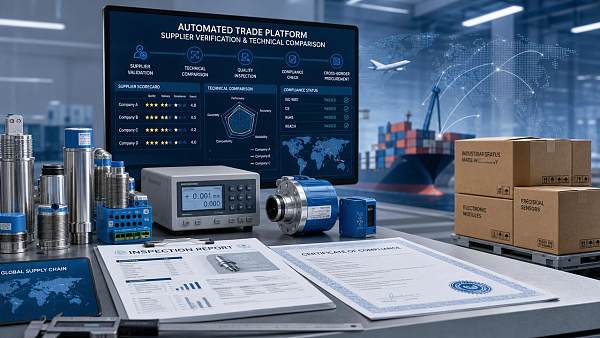
A modern automated trade platform is expected to make compliance visible before a transaction is finalized. That includes standards references, test records, declarations, origin information, and change tracking across product revisions.
This is particularly relevant in markets influenced by ISO/IEC 17025, IEEE, NIST, export controls, and sector-specific qualification rules. Missing evidence is no longer a back-office inconvenience. It is a material sourcing risk.
2. Supplier intelligence moves beyond directories
Supplier discovery is becoming more analytical. Rather than listing vendors in a broad category, platforms are beginning to score them through delivery reliability, certification depth, documentation responsiveness, dispute frequency, and technical specialization.
For complex equipment sourcing, this can be more valuable than a large catalog. The question is not who can supply a part number. The real question is who can support validated performance under the required operating standard.
3. Technical benchmarking enters the sourcing workflow
One of the most important developments is the integration of technical benchmarking into trade decisions. In sectors covered by G-IMS, commercial choice increasingly depends on benchmarked performance rather than vendor narrative alone.
G-IMS reflects this shift clearly. Its model connects raw sensory hardware with the data-intelligence protocols needed for a zero-defect industrial future. That logic is now influencing what a serious automated trade platform must deliver.
When buyers compare photonic sensors, non-contact vision systems, high-frequency measurement tools, or advanced metrology equipment, benchmark context shortens evaluation cycles and reduces ambiguity.
4. Cross-border efficiency depends on structured data quality
Cross-border automation is often discussed in terms of customs speed or payment processing. In reality, structured product data is the bigger issue. Inconsistent naming, incomplete specifications, and unverified substitutions create friction long before goods move.
An automated trade platform that normalizes technical attributes, compliance fields, and document sets can prevent many of the delays that appear later as logistics problems.
5. AI support shifts from recommendation to exception detection
AI features will remain important, but the most credible use cases are practical. In 2026, useful AI inside an automated trade platform is likely to focus on anomaly detection, missing certificates, unusual lead-time shifts, spec mismatches, and supplier behavior changes.
This is more valuable than generic product recommendations. In industrial sourcing, the cost of a wrong suggestion is far higher than the inconvenience of a slower search.
Where these changes matter most
Not every category requires the same level of platform intelligence. The most immediate value appears where procurement decisions depend on measurable performance, documentation integrity, and lifecycle traceability.
These are the areas where G-IMS provides useful context. Its benchmarking orientation supports a more rigorous reading of platform data, especially when commercial decisions depend on verified technical evidence.
What to examine before trusting an automated trade platform
Platform growth does not automatically mean platform quality. A polished interface can still hide weak data governance, shallow supplier screening, or incomplete technical coverage.
A careful evaluation usually benefits from a few direct checks:
- Whether supplier records include verifiable standards, test reports, and revision history.
- Whether product attributes are structured enough for side-by-side technical comparison.
- Whether alerts identify document gaps, substitution risks, or unusual commercial changes.
- Whether the automated trade platform supports multi-region compliance logic.
- Whether benchmarking inputs come from credible technical sources rather than marketing claims.
In other words, the right platform should reduce interpretation effort without hiding complexity. It should make critical distinctions easier to see, not easier to ignore.
A more practical way to use platform data
The most effective use of an automated trade platform is not to replace human judgment. It is to structure that judgment around better evidence. This is where many sourcing programs become stronger in 2026.
A practical workflow often starts with commercial filters, then moves quickly into technical validation. After that, logistics feasibility and compliance completeness can be tested against the intended operating environment.
For categories influenced by measurement science, that sequence is especially useful. It mirrors the logic behind G-IMS: actionable insight comes from connecting hardware data, standards context, and decision relevance.
Signals of a stronger 2026 platform model
- It links commercial records with technical and regulatory evidence.
- It supports comparison across suppliers, not just individual product pages.
- It identifies risks early enough to change sourcing decisions.
- It reflects real industrial complexity without becoming unusable.
What to watch next
By 2026, the automated trade platform will be judged less by how many transactions it processes and more by how reliably it supports high-stakes choices. That is the real trend beneath the technology language.
The next step is not simply adopting more automation. It is clarifying which sourcing decisions require deeper evidence, which categories need benchmarked comparison, and which compliance signals deserve continuous monitoring.
A useful starting point is to map current procurement workflows against data gaps. From there, compare whether the automated trade platform in use can support technical validation, standards alignment, and supplier confidence at the level the category demands.
Where that gap remains wide, better platform selection and stronger benchmarking inputs will likely define the quality of sourcing decisions in the year ahead.
Recommended News
 Aug 10, 2026Next-Gen Wireless Charging for Smartphones: What Improves Speed, Heat, and Compatibility?Next-gen wireless charging for smartphones is improving speed, reducing heat, and boosting compatibility. Learn what Qi2, alignment, and thermal control mean before you buy.
 Jul 04, 2026Electronics Measurement Solutions Cost: What Drives Total Ownership in 2026Electronics Measurement Solutions cost in 2026 goes beyond unit price. Learn what drives total ownership, from calibration and software to downtime, upgrades, and long-term ROI.
 Jun 16, 2026Relay Modules Troubleshooting for Unstable Signalsrelaymodules troubleshooting guide for unstable signals: identify power, wiring, EMI, and contact faults fast to reduce downtime, restore stability, and prevent repeat failures.
 Jun 15, 2026Automated Trade Platform Trends to Watch in 2026Automated trade platform trends for 2026 reveal how smarter compliance, supplier intelligence, AI exception detection, and technical benchmarking can improve sourcing decisions worldwide.
 Jun 07, 2026Workspace Design Trends 2026: Layouts That Improve FocusWorkspace design trends for 2026 focus on layouts that reduce distractions, support hybrid work, and improve performance. Discover evidence-led ideas that boost focus and productivity.
 Jun 06, 2026Smart Hotel Price Models: What Affects Total Cost?Smart hotel price explained: discover what really affects total cost, from devices and integration to compliance, maintenance, and long-term ROI before you compare quotes.
 May 31, 20263D Scanning Mesh Quality Benchmarks That Actually Affect Accuracy3d scanning mesh quality benchmarks that reveal accuracy risks in density, noise, holes, edges, and repeatability—helping teams trust scan data before critical decisions.
 May 21, 2026Electrical Test Equipment Supplier Checklist for Lower Downtime RiskElectrical Test equipment supplier checklist for lower downtime risk: compare calibration, loaner support, response speed, and lifecycle service to protect uptime and buy with confidence.
 May 21, 2026Spectrum Analyzers for RF Testing: Key Specs That Impact Test ConfidenceSpectrum Analyzers for RF testing: learn which specs truly affect confidence—DANL, phase noise, RBW, dynamic range, and accuracy—to choose smarter and trust every RF result.
 May 13, 2026How to Vet an Electrical Test Equipment SupplierElectrical Test equipment supplier selection affects accuracy, compliance, and uptime. Learn how to vet suppliers with practical criteria for traceability, service, and long-term value.
 May 03, 2026How to Compare an Electrical Test Equipment SupplierElectrical Test equipment supplier comparison starts with application fit. Learn how to evaluate accuracy, compliance, support, and delivery to reduce risk and choose with confidence.
 May 02, 2026High Frequency Measurement Errors That Distort Real ResultsHigh Frequency Measurement errors can quietly distort critical test results. Learn the main causes, reduce uncertainty, and make smarter validation and procurement decisions.
 Apr 24, 2026Why Spectrum Analyzers Miss Intermittent RF ProblemsSpectrum Analyzers for RF testing can miss intermittent faults. Learn how Electrical Test equipment, NIST Standards for calibration, and smarter capture methods improve RF troubleshooting.
 Apr 24, 2026Electrical Test Errors That Come From Fixture DesignElectrical Test errors often start in fixture design. Learn how Spectrum Analyzers, Industrial Sensors, IEEE Standards, and NIST Standards help improve accuracy, repeatability, and production confidence.