Metrology Software Wholesale: Integration Risks to Check
Time
Click Count
For project managers and engineering leads, metrology software wholesale can accelerate deployment across plants, labs, and supplier networks—but integration failures can quickly erase those gains. Before scaling any platform, it is critical to verify data compatibility, equipment interoperability, compliance traceability, cybersecurity, and long-term vendor support. This article highlights the key integration risks that should be checked early to protect precision, timelines, and investment value.
Why integration risk matters more than license price
In metrology software wholesale projects, the visible cost is often the software contract, but the hidden cost sits in integration. A platform that looks affordable can become expensive once teams discover incompatible CMM outputs, unstable API behavior, duplicated calibration records, or missing audit trails.
For project managers, the risk is not theoretical. Delays in one plant can block PPAP, first article inspection, supplier qualification, or regulated release workflows. In multi-site operations, every integration gap multiplies across machines, users, and reporting layers.
G-IMS approaches this issue from the standpoint of measurement-to-action performance. That means the software is not judged only by interface design or standalone analytics, but by how reliably it connects advanced metrology, optical sensing, electrical test, non-contact inspection, and compliance-driven data governance.
- A failed integration can create rework loops between quality, engineering, and IT.
- A partially connected system often produces inconsistent measurement histories across sites.
- A poorly governed rollout can weaken traceability under ISO/IEC 17025, customer audits, or internal CAPA workflows.
What should be checked first in metrology software wholesale?
Before comparing vendors in depth, project teams should define the integration perimeter. Many procurement errors happen because buyers evaluate features without mapping the full measurement ecosystem: devices, protocols, file formats, ERP or MES touchpoints, approval logic, user roles, and validation requirements.
The checklist below is useful when metrology software wholesale will support multiple sites, mixed equipment generations, or supplier-facing workflows.
This table shows why metrology software wholesale should be treated as an operational integration program, not only a purchasing event. The earlier each area is verified, the lower the risk of late-stage reconfiguration.
Data compatibility: the first failure point in multi-site deployment
Why file support alone is not enough
Vendors may claim broad import capability, but project managers should ask deeper questions. Can the system preserve feature definitions, tolerance context, datum structure, measurement uncertainty notes, and revision history? A file that opens is not always data that remains decision-ready.
This issue becomes more critical when wholesale deployment covers acquired factories, contract manufacturers, and mixed hardware fleets. Some sites may still rely on older export formats, while others generate richer digital inspection datasets.
What to test before rollout
- Import the same part program from at least three device types and compare result fidelity.
- Validate unit handling across metric and imperial environments.
- Check whether historical records remain searchable after migration.
- Confirm how the platform handles schema changes during software upgrades.
G-IMS benchmarking practice is especially useful here because measurement data often crosses domains. A plant may combine 3D scanning, optical inspection, electrical measurement, and environmental monitoring in one quality workflow. Data architecture must support this reality from the start.
Equipment interoperability: can one platform truly connect your measurement stack?
In metrology software wholesale, interoperability claims should be treated carefully. A vendor may support a device family, yet not the exact firmware version, driver generation, or command set used on your floor. This matters when uptime targets are tight and engineering teams cannot pause production for custom rewrites.
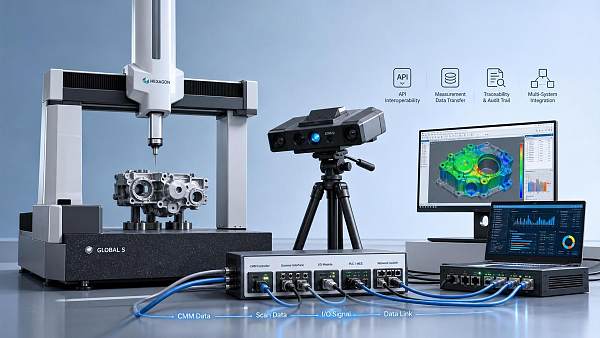
The challenge is broader than CMM integration. Modern quality environments often include laser scanners, industrial cameras, machine vision cells, profilometers, photonic sensors, oscilloscopes, or specialized analyzers. If the software cannot normalize data flows or orchestrate these sources, teams fall back to spreadsheets and manual approvals.
The comparison below helps project managers classify common interoperability exposure during metrology software wholesale evaluation.
The main lesson is simple: do not accept generic compatibility statements. Ask for proof at the exact device, software, and workflow level that your program depends on.
Compliance traceability: where quality systems and software architecture meet
Project managers often inherit strict documentation requirements from customers, regulators, or accreditation bodies. In that context, metrology software wholesale must support more than result storage. It should preserve who measured what, with which method, under which calibration status, and after which revision approval.
Traceability gaps are expensive because they often surface late. A team may discover missing approval chains during a customer audit or find that uncertainty-related context was not retained during migration from a legacy database.
- Check whether calibration status can be linked to measurement sessions and device identities.
- Review audit log granularity for edits, overrides, result deletion, and e-sign approval events.
- Confirm record retention rules for regulated or customer-mandated periods.
- Ensure exported reports retain enough metadata for external review and root-cause investigation.
Because G-IMS benchmarks systems against frameworks such as ISO/IEC 17025, IEEE, and NIST-referenced measurement practices, decision-makers can frame software selection around defensible traceability rather than interface preference alone.
Cybersecurity and access control: often ignored until supplier access expands
Many metrology teams focus on accuracy and reporting, while IT focuses on network security. In metrology software wholesale, these worlds meet. The moment software connects multiple plants, cloud repositories, or supplier portals, the attack surface expands.
This does not mean every deployment needs the same architecture. It means project leaders should require a documented security model before procurement closes.
Minimum questions to ask vendors
- How are user roles separated between operators, quality managers, auditors, and external suppliers?
- What is the patching and vulnerability response process?
- Can data be encrypted in transit and at rest under your target environment?
- How is remote troubleshooting controlled and logged?
For project managers, the practical goal is continuity. A secure but unworkable system causes user bypass. An easy but weak system creates exposure. The right platform supports both disciplined access and daily inspection efficiency.
Vendor support, upgrade path, and lifecycle risk
A common mistake in metrology software wholesale is to evaluate support only after implementation starts. Yet lifecycle risk can outweigh feature differences. If your vendor cannot support regional rollout, data migration, workflow tuning, or staged validation, the internal project team becomes the integration buffer.
This is where wholesale decisions differ from single-license purchases. The question is not whether the software works today. The question is whether it remains governable across upgrades, acquisitions, supplier onboarding, and hardware refresh cycles.
Support criteria worth putting into the contract
- Named response times for critical integration incidents.
- Defined responsibilities for connector maintenance after software upgrades.
- Migration support for legacy datasets and archived inspection history.
- Training scope by user role, including administrators and validation owners.
When these points are vague, implementation risk shifts to the buyer. That is rarely acceptable for engineering programs with fixed launch milestones.
A practical procurement guide for project managers
If you are leading a metrology software wholesale initiative, build the decision process around evidence, not feature lists. Cross-functional validation is essential because quality, production, IT, and procurement often define success differently.
Recommended evaluation sequence
- Map all measurement assets, data sources, and downstream systems by site.
- Classify workflows into production-critical, compliance-critical, and analytics-enhancement categories.
- Run a pilot using real devices, real users, and representative part families.
- Score vendors on integration evidence, not presentation claims.
- Define a phased rollout with acceptance gates for data integrity, uptime, and traceability.
This method reduces the chance that metrology software wholesale becomes an IT migration with weak shop-floor adoption. It keeps the program tied to measurable operating outcomes.
FAQ: common questions before scaling metrology software wholesale
How do we know if a platform fits both lab and production use?
Check whether the platform can handle controlled methods, revision governance, and high-volume result ingestion at the same time. Lab environments may need deeper method flexibility, while production needs stability, quick reporting, and low operator friction. A pilot should test both conditions.
What is the biggest hidden cost in metrology software wholesale?
Usually it is not the license. The biggest hidden cost is post-purchase integration effort: data cleaning, connector development, validation cycles, retraining, and reporting redesign. That is why proof-based compatibility checks matter early.
Should we replace all legacy systems at once?
In most cases, no. A phased approach is safer. Start with sites or workflows where data fragmentation creates the highest operational cost. Preserve archive access and define a coexistence plan before full migration.
Which standards should influence software selection?
The answer depends on your environment, but many teams review software capabilities against ISO/IEC 17025-aligned traceability needs, customer quality requirements, internal audit procedures, and recognized measurement governance practices such as NIST-referenced calibration logic where relevant.
Why choose us for metrology software wholesale assessment
G-IMS supports decision-makers who need more than product brochures. Our strength is technical benchmarking across advanced metrology, 3D scanning, industrial optics, high-frequency measurement, non-contact vision inspection, and specialized sensing environments. That cross-domain perspective helps project managers identify integration risk before it affects launch schedules or quality performance.
If you are evaluating metrology software wholesale, you can contact us for structured support on parameter confirmation, device compatibility review, rollout planning, data traceability requirements, supplier-network deployment logic, upgrade-path assessment, and quote-stage comparison criteria.
We can also help you narrow options for multi-site implementation, define pilot acceptance checkpoints, review compliance-sensitive workflows, and prepare vendor questions around delivery timing, migration scope, training needs, and long-term support obligations. For engineering leads under schedule pressure, that clarity can prevent expensive integration surprises later.
Recommended News
 Oct 02, 2026When vision measuring machines deliver the accuracy a part requiresVision Measuring Machines for dimensional inspection: learn when optical metrology delivers reliable accuracy, validated uncertainty, and faster quality decisions.
 Sep 25, 2026When does tech consulting pay off for an AI metrology project?Tech consulting pays off in AI metrology when it reduces measurement risk, improves vendor selection, and supports reliable production decisions.
 Sep 23, 2026How AI metrology systems for electronics improve PCB inspection accuracyAI Metrology Systems for electronics improve PCB inspection accuracy with calibrated measurement, intelligent defect classification, traceability, and actionable process insights.
 Aug 15, 2026How to benchmark a metrology system before making a purchaseMetrology system benchmarking helps buyers compare accuracy, repeatability, compliance, and total cost before purchase.
 Aug 13, 2026How to Compare Bridge Coordinate Measurement Systems for Accuracy, Volume, and ThroughputBridge coordinate measurement systems compared the smart way: learn how to balance accuracy, measurement volume, and throughput to choose a CMM that fits real parts, workflows, and production goals.
 Aug 12, 2026How to Evaluate Industrial Measurement Systems for Assembly Tolerance ControlIndustrial measurement systems for assembly: learn how to evaluate accuracy, repeatability, integration, and cycle time to improve tolerance control and avoid costly selection mistakes.
 Jul 18, 2026How to Evaluate Automatic Vision Measuring Machines for Accuracy and ThroughputAutomatic Vision Measuring Machines: learn how to evaluate accuracy, repeatability, software, and real-world throughput to choose a system that boosts quality and production confidence.
 Jul 12, 2026How to Compare 3D Optical Measurement Systems for Tight-Tolerance Parts3D optical measurement systems for tight-tolerance parts: learn how to compare accuracy, repeatability, surface handling, software, and traceability to choose with confidence.
 Jul 11, 2026Inline Metrology System Pricing: What Drives Total Cost in 2026Inline metrology system pricing in 2026 depends on more than hardware. Learn the real cost drivers—software, integration, uptime, and ROI—to compare vendors and approve budgets with confidence.
 Jul 11, 2026Non-Contact Metrology System for Electronics: Key Accuracy FactorsNon-contact metrology system for electronics: discover the key factors behind true accuracy, from optics and calibration to software, drift, and reflective surfaces.
 Jul 10, 2026When a Measurement Platform for Automation Improves ThroughputMeasurement platform for automation boosts throughput by speeding inspection, reducing drift, and enabling faster corrective action. See how smarter measurement drives yield, quality, and ROI.
 Jul 09, 2026Vision Measuring Machines for PCB Inspection: What Affects Accuracy MostVision Measuring Machines for PCB inspection: discover the key factors that impact accuracy most, from optics and lighting to calibration and software, and learn how to improve PCB quality control.
 Jul 09, 20263D Scanning Factory Setup: Common Errors and How to Avoid Them3D scanning factory setup often fails before launch due to poor planning, weak validation, and disconnected data. Learn the common errors and how to avoid costly rework.
![]() Jul 07, 2026Automated Dimensional Measurement Systems: Key Accuracy Limits to CheckAutomated dimensional measurement systems: learn the key accuracy limits to check, from calibration drift to environmental effects, and compare platforms with confidence.
Jul 07, 2026Automated Dimensional Measurement Systems: Key Accuracy Limits to CheckAutomated dimensional measurement systems: learn the key accuracy limits to check, from calibration drift to environmental effects, and compare platforms with confidence. Jul 06, 2026Closed Loop Automated Metrology for Faster Process ControlClosed loop automated metrology helps manufacturers speed process control, reduce scrap, and correct variation in real time. Learn how it improves quality, uptime, and production stability.
 Jul 03, 2026How to Compare an Aerospace Measurement Supplier Beyond PriceAerospace measurement supplier selection goes beyond price. Learn how to compare calibration, traceability, software, service, and lifecycle value to reduce risk.
 Jul 03, 2026Industrial Measurement Equipment Cost: What Drives the BudgetIndustrial measurement equipment cost depends on more than price. Learn what drives budget, hidden lifecycle expenses, compliance, software, and downtime risk to compare options smarter.
 Jul 02, 2026Choosing a Non-Contact Metrology System for AutomationNon-contact metrology system for automation: learn how to balance accuracy, speed, integration, and ROI to choose a solution that improves quality and keeps production moving.
 Jul 02, 2026Touch Probe vs Scanning CMM: Which Fits Better?Coordinate Measuring Machines touch probe or scanning CMM? Compare speed, data depth, and cost to choose the best fit for your inspection needs.
 Jul 02, 2026How Inline Metrology Improves Manufacturing YieldManufacturing inline metrology helps improve yield by catching drift, defects, and process variation in real time. Learn how the right fit boosts quality, control, and throughput.
 Jul 01, 2026Coordinate Measuring Machines Optical: Selection Guide by Use CaseCoordinate Measuring Machines optical selection starts with use case. Learn how to match accuracy, throughput, geometry, and data workflow to choose the right system.
 Jun 24, 2026Smart Hotel Energy Efficiency: Where Savings Actually Come FromSmart hotel energy efficiency starts with better measurement and control—not just new devices. Learn where real hotel energy savings come from and how to improve comfort, performance, and ROI.
 Jun 18, 2026Metrology Software API Interoperability: Key Checks Before IntegrationMetrology software API interoperability explained: learn the 6 key checks to verify data integrity, traceability, scalability, and compliance before integration.
 Jun 15, 2026High Accuracy Quality Control Systems ExplainedHigh Accuracy Quality Control Systems explained: learn how precision metrology, analytics, and traceable standards reduce defects, improve compliance, and strengthen smarter manufacturing decisions.