How temperature compensation affects conductivity and pH readings
Time
Click Count
How temperature compensation affects conductivity and pH readings
Temperature can shift conductivity and pH readings enough to distort process decisions, sensor comparisons, and quality assessments. Yet temperature compensation does not mean the same thing for both measurements. Conductivity algorithms typically normalize readings to a reference temperature; pH compensation adjusts electrode response without eliminating the sample’s temperature-dependent chemistry.
This distinction matters when a laboratory result disagrees with an inline analyzer. Both instruments may be working correctly while reporting different quantities or measuring a sample whose chemistry changed during cooling. Before adjusting calibration, establish what each displayed value actually represents.
Two measurements, two different compensation jobs
Conductivity describes how readily a solution carries electrical current. It depends on the concentration, charge, and mobility of dissolved ions. Temperature changes ion mobility and can also alter chemical equilibria. Consequently, a conductivity reading taken in a warm process stream is not directly comparable with one taken after the sample cools.
A compensated conductivity value estimates what the solution would read at a specified reference temperature, commonly 25°C. That estimate is only as good as the relationship assumed between temperature and conductivity.
A glass pH electrode works differently. It develops a potential related to hydrogen-ion activity, and its theoretical sensitivity changes with absolute temperature. Automatic temperature compensation, or ATC, adjusts the conversion from electrode voltage to pH. It does not normally convert the sample’s actual pH to the pH it would have at 25°C.
The practical rule: compensated conductivity usually means a reference-temperature estimate. Temperature-compensated pH usually remains the pH at the sample’s measurement temperature.
Conductivity compensation works until the model stops fitting
A common linear correction uses a temperature coefficient, often entered as percent change per degree Celsius. In simplified form:
κref = κT / [1 + α(T − Tref)]
Here, κT is measured conductivity, κref is estimated conductivity at the reference temperature, and α is the coefficient expressed as a decimal per degree. The instrument may instead use a nonlinear curve or a solution-specific algorithm, so this equation should not be assumed to describe every transmitter.
Consider an illustrative calculation, not a universal fluid property. With α set to 0.02 per °C, a measured value of 1,200 µS/cm at 35°C becomes 1,000 µS/cm at a 25°C reference. The calculation is straightforward. The difficult question is whether 0.02 accurately describes that solution across that temperature interval.
A fixed coefficient can be useful for a stable electrolyte mixture over a limited operating range. It becomes less defensible when concentration, composition, or temperature varies substantially. Acid and caustic solutions, mixed process liquors, and very low-conductivity water should not automatically inherit a general-purpose salt-solution setting.
Nonlinear compensation is not inherently better. A curve developed for one water composition can be inappropriate for another. Ultrapure water is particularly demanding because water’s own dissociation contributes to conductivity, while trace contamination may have a different temperature dependence. A dedicated compensation mode needs an application match, not merely an impressive name.
There is also an operational trap in cleaning systems: if conductivity is being used to infer chemical concentration, temperature correction alone does not establish concentration. The concentration model must also fit the chemical, operating range, and potential contamination. A correctly compensated reading can still produce an incorrect concentration estimate.
Why pH can change even with ATC enabled
The theoretical Nernst slope of a pH electrode is approximately 59.16 mV per pH unit at 25°C. Its magnitude increases as absolute temperature rises. ATC uses the measured temperature to account for this sensitivity change when calculating pH from electrode potential.
Real electrodes also have offsets, aging effects, and reference-junction behavior. ATC does not repair a contaminated junction, restore a dehydrated glass membrane, or eliminate drift caused by an unsuitable reference system. A temperature input is one part of the measurement chain, not a general correction for electrode health.
More importantly, the solution itself changes with temperature. Acid dissociation, base equilibria, and water dissociation are temperature dependent. Neutrality means equal hydrogen-ion and hydroxide-ion activities; it does not mean that neutral pH must always be 7.00. That familiar value applies approximately to pure water at 25°C.
A warm buffer or process liquid can therefore have a genuinely different pH from the same liquid when cooled. ATC should allow the electrode to report that change rather than hide it. Some instruments offer a separate solution-temperature correction, but this requires a validated sample-specific relationship and must be distinguished from ordinary electrode compensation.
For a heated reaction vessel, the relevant control variable may be pH at operating temperature. For a release test, the method may require measurement after conditioning the sample to a defined temperature. Neither approach is universally preferable. Problems arise when the control room and laboratory use different definitions without documenting them.
Temperature measurement can be the weak link
An accurate temperature element can still provide the wrong temperature for compensation. In a flow cell, the sensing element may respond more slowly than the conductivity electrodes or pH membrane. During a hot-to-cold transition, the analyzer then combines an electrical measurement from one thermal condition with a temperature reading representing another.
Placement matters as much as the specification. A separate temperature probe upstream of a cooled sampling line may not represent conditions at the analytical sensor. An integrated element reduces this spatial mismatch, but it does not guarantee identical response times.
In practice, transient errors can look like process excursions. A conductivity spike after a temperature step may reflect thermal lag rather than contamination. A pH reading that drifts after immersion may involve both thermal equilibration and electrode stabilization. Diagnose the timing before changing a coefficient or recalibrating the sensor.
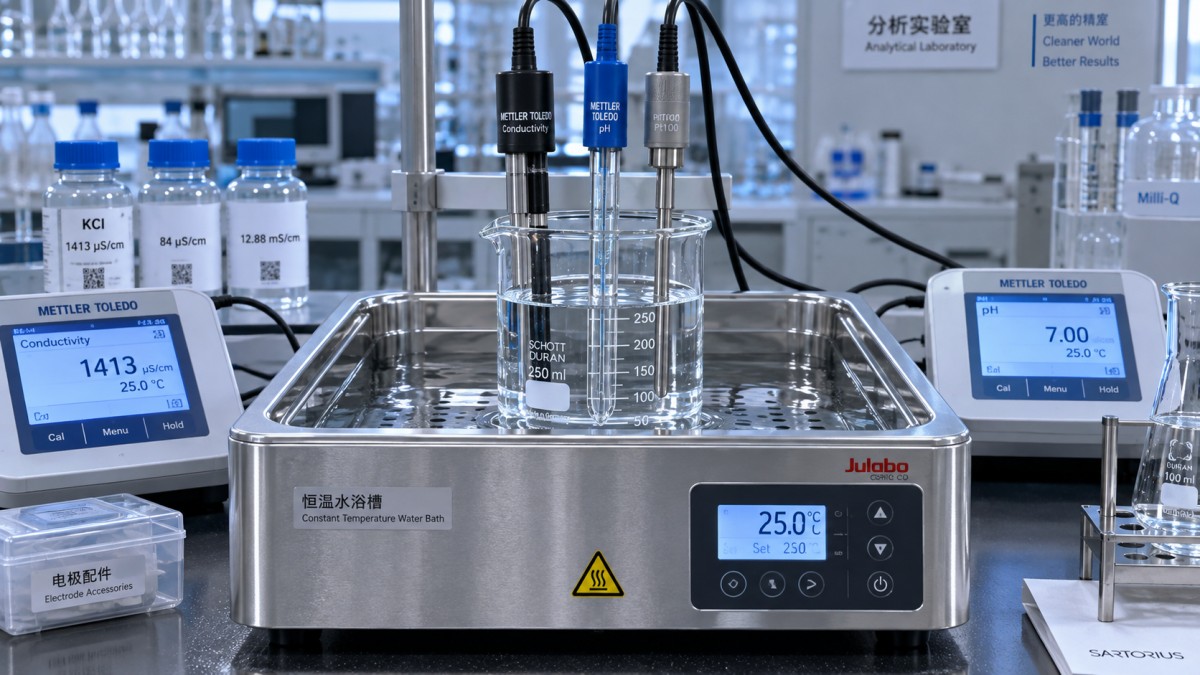
An evaluation should therefore include temperature ramps or representative process transitions, not only measurements in an equilibrated beaker. Compare raw conductivity, compensated conductivity, sample temperature, and stabilization behavior. For pH, examine temperature and electrode diagnostics alongside the reported value where those outputs are available.
Calibration must preserve the temperature basis
Conductivity standards have temperature-dependent values. Check the certificate or supplier’s temperature table and determine how the instrument applies compensation during cell-constant calibration. A mismatch between the entered standard value, actual temperature, and correction mode can produce a plausible but biased calibration.
For pH, use the buffer’s assigned value at its actual temperature. Instruments with automatic buffer recognition may apply stored temperature tables, but the selected buffer family must match the buffers used. Recognition by nominal pH alone is not enough to establish that the correct table is active.
Allow the buffer, electrode, and temperature element to equilibrate. Calibration near the operating temperature can reduce some practical mismatches, although it does not reproduce every process condition. High ionic strength, junction potentials, pressure, and fouling may still distinguish the process measurement from calibration in a clean buffer.
Manual temperature entry is reasonable for a stable, verified laboratory condition. It is a poor substitute for live temperature measurement in a changing process. Likewise, cooling a grab sample does not necessarily preserve its original chemistry: gas exchange, precipitation, or continued reaction can change the result independently of compensation.
What to verify in specifications and acceptance testing
The useful procurement question is not simply whether an analyzer has ATC. It is whether its measurement basis is explicit and its correction method remains valid under actual conditions. A short technical review should establish:
- The reported quantity: raw conductivity, reference-temperature conductivity, or pH at measurement temperature.
- The correction method: linear coefficient, nonlinear model, selectable fluid curve, or separate sample-pH correction.
- The validated range: temperature, conductivity, composition, and any restrictions stated for the algorithm.
- The temperature channel: accuracy, location, response time, and behavior if the input fails.
- Data handling: whether the transmitter, controller, or historian applies correction, preventing accidental double compensation.
Acceptance testing should separate sensor performance from model performance. Check conductivity cell response against suitable standards, verify temperature against a traceable reference, and then assess compensation using representative solutions at several equilibrated temperatures. A standard that validates the cell constant does not automatically validate the correction model for the process fluid.
For pH, evaluate calibration quality and repeatability before interpreting a temperature sweep. Do not assume that a stable sample must show constant pH as temperature changes. Without an independent expectation for the sample’s temperature-dependent chemistry, that test cannot isolate electrode error from real chemical change.
This separation fits the technical-benchmarking approach of Global Intelligent-Measurement & Sensory-Tech (G-IMS): assess the complete path from sensor response to actionable data, rather than treating a feature label as evidence of accuracy. In an ISO/IEC 17025 laboratory context, method suitability, traceability, and measurement uncertainty matter; the framework does not make every compensation algorithm valid for every matrix.
Temperature-related uncertainty belongs in the assessment alongside calibration uncertainty, repeatability, and sampling effects. For conductivity, uncertainty in the coefficient or model may outweigh temperature-sensor uncertainty. For pH, thermal mismatch and sample alteration may dominate an otherwise good electrode calibration.
When conductivity and pH results disagree across instruments, compare the measurement temperature, compensation settings, sample handling, and reporting basis before adjusting either device. Record those details with the result. A number without its temperature context may be readable, but it is not necessarily comparable—or suitable for the decision being made.
Recommended News
 Oct 18, 2026What causes high permeate conductivity in reverse osmosis systems?Diagnose high permeate conductivity in reverseosmosissystems. Discover key causes, verify salt rejection, and find practical checks to avoid unnecessary membrane replacement.
 Oct 18, 2026How temperature compensation affects conductivity and pH readingsConductivity and pH readings respond differently to temperature compensation. Learn how to avoid calibration errors, compare results accurately, and improve process control.
 Oct 17, 2026Conductivity vs pH in water testing and why neither replaces the otherConductivity vs pH: discover why neither replaces the other in water testing. Learn what each reveals, avoid misleading readings, and make smarter water-quality decisions.
 Oct 08, 2026How to choose a benchtop pH meter for routine quality controlBenchtop pH meter buying guide for routine QC: compare accuracy, electrodes, calibration, temperature control, and data integrity to choose reliable results.
 Aug 05, 2026How to Compare Portable Water Quality Sensors for pH, Conductivity, and Field AccuracyPortable water quality sensors compared the right way: learn how to evaluate pH, conductivity, field accuracy, usability, and maintenance before you buy.
 Jul 14, 2026Conductivity Meters Europe: 2026 Market Shifts, Standards, and Buying RisksConductivity meters Europe in 2026: explore market shifts, compliance standards, calibration risks, and smart buying tips to reduce downtime and improve process control.
 Jun 29, 2026Water Treatment Conductivity Sensors: Common Selection Mistakes and FixesWater treatment conductivity sensor selection often fails due to range-only decisions, poor temperature compensation, and installation mistakes. Learn the common errors and practical fixes to improve stability, cut maintenance, and protect process performance.
 Jun 20, 2026Flowmeters Selection Guide for Stable Process ControlFlowmeters selection guide for stable process control: compare technologies, avoid costly mistakes, and choose the right meter for accuracy, uptime, compliance, and smarter operations.
 Jun 20, 2026How Smart Water Management Cuts Utility WasteSmart Water Management helps facilities detect leaks, reduce utility waste, and improve operational resilience with real-time visibility, faster response, and measurable cost savings.
 Jun 17, 2026Industrial Water Management: Key Risks and Control MethodsIndustrial Water management: learn the key risks, early warning signs, and proven control methods to reduce downtime, protect quality, and improve compliance.
 Jun 16, 2026Automatic Backwash Filter OEM Cost Factors ExplainedAutomatic backwash filter OEM cost factors explained: compare materials, micron rating, automation, compliance, and OEM capability to avoid hidden costs and choose the right supplier.
 Jun 14, 2026Clarifier System Factory Checklist: Capacity, Compliance, ServiceClarifier system factory selection goes beyond price. Compare real capacity, compliance records, engineering depth, and after-sales service to reduce risk and choose a reliable long-term partner.
 Jun 13, 2026Reverse Osmosis Maintenance Services: What Affects Service Cost?Reverse Osmosis maintenance services: learn what really drives service cost, from water quality and service scope to technician expertise, downtime risk, and contract value.
 Jun 11, 2026Reverse Osmosis Maintenance Services: Cost Drivers and Service ScopeReverse Osmosis maintenance services explained: compare true cost drivers, service scope, exclusions, and preventive value to reduce downtime and protect membrane life.
![]() Jun 09, 2026High Pressure Pumps for RO Wholesale: Cost, Lead Time, and Failure RisksHigh pressure pumps for RO wholesale: compare true cost, lead time, and failure risks before you buy. Learn how to avoid delays, hidden expenses, and unstable system performance.
Jun 09, 2026High Pressure Pumps for RO Wholesale: Cost, Lead Time, and Failure RisksHigh pressure pumps for RO wholesale: compare true cost, lead time, and failure risks before you buy. Learn how to avoid delays, hidden expenses, and unstable system performance.![]() Jun 09, 2026Digital Twin Platform for Desalination: Key Benefits, Risks, and ROIDigital Twin platform for desalination: explore key benefits, major risks, and practical ROI drivers to cut energy costs, reduce downtime, and make smarter plant investment decisions.
Jun 09, 2026Digital Twin Platform for Desalination: Key Benefits, Risks, and ROIDigital Twin platform for desalination: explore key benefits, major risks, and practical ROI drivers to cut energy costs, reduce downtime, and make smarter plant investment decisions. May 29, 2026Digital Twin for Water Infrastructure Monitoring: Key Data Risks to CheckDigital Twin for water infrastructure monitoring helps reduce data risks by checking sensor accuracy, telemetry gaps, model trust, cybersecurity, and interoperability.