Non Contact Inspection for Fragile Parts: Key Tradeoffs
Time
Click Count
For fragile parts, Non Contact Inspection is shifting from a niche option to a core quality strategy. It reduces handling risk, supports repeatable measurement, and aligns with zero-defect manufacturing.
Yet the decision is rarely simple. Every Non Contact Inspection method introduces tradeoffs in resolution, cycle time, surface response, data volume, integration effort, and validation burden.
Across electronics, medical components, aerospace structures, optics, and precision assembly, the evaluation focus is changing. The question is no longer whether to inspect without contact, but which approach creates reliable value.
Why Non Contact Inspection is gaining urgency across fragile-part production
Current manufacturing conditions are pushing inspection strategies toward lower-force, higher-data methods. Fragile parts are becoming thinner, lighter, smaller, and more complex in geometry and material behavior.
At the same time, defect tolerance is shrinking. A slight surface scratch, micro-crack, edge chip, or coating variation can trigger field failure, compliance issues, or expensive downstream scrap.
Traditional contact gauging still has value, especially for stable dimensions and rugged parts. However, fragile components often deform under force, shift during fixturing, or suffer handling damage before measurement is complete.
This is why Non Contact Inspection is expanding in both lab and inline environments. It supports safer measurement while enabling broader digital traceability for quality analytics and process control.
The strongest trend signals point to smarter, more selective inspection choices
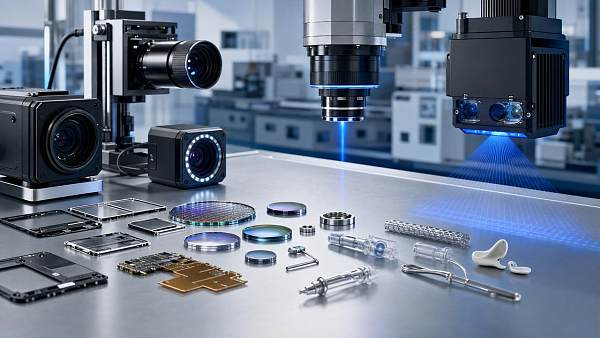
The market is not moving toward one universal technology. Instead, it is moving toward selective combinations of machine vision, laser scanning, structured light, confocal sensing, interferometry, and multisensor platforms.
This shift reflects a deeper understanding. Different fragile parts fail in different ways, so Non Contact Inspection must match failure mode, material type, throughput target, and regulatory expectation.
Several trend signals are especially clear:
- 2D vision is being paired with 3D measurement to reduce false acceptance.
- Higher-resolution systems are increasingly filtered through ROI and takt-time limits.
- Software performance now matters almost as much as optical hardware.
- Metrology-grade validation is becoming essential in regulated or safety-critical sectors.
- Hybrid inspection cells are replacing single-tool assumptions.
The tradeoffs behind Non Contact Inspection are becoming more visible
The appeal of Non Contact Inspection is clear, but fragile-part measurement exposes its limits quickly. The right decision depends on what must be detected, not on general technology popularity.
Key drivers shaping method selection
Common technology tradeoffs in practice
Machine vision is fast and scalable. It works well for presence, orientation, edge quality, and surface anomalies. However, pure 2D vision may miss height variation or subsurface geometry issues.
Laser triangulation can provide useful 3D profile data at production speed. Still, shiny or transparent fragile parts often create noisy returns, forcing filtering, angle changes, or special lighting control.
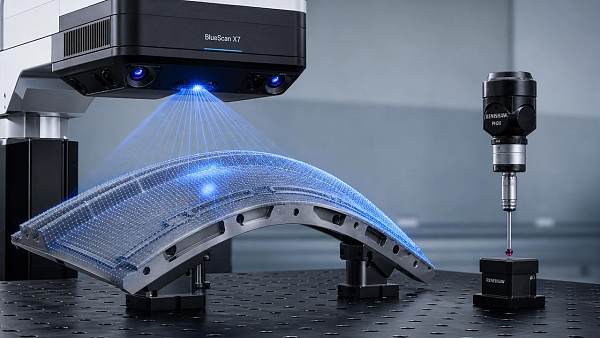
Structured light offers full-field 3D capture and broad coverage. Yet it may struggle with deep cavities, steep edges, or highly reflective coatings, especially in demanding tolerance ranges.
Confocal and interferometric methods deliver excellent precision for critical surfaces. The tradeoff is typically slower acquisition, tighter environmental requirements, and more limited suitability for high-speed inline deployment.
This is why Non Contact Inspection should be judged by inspection objective. A fast reject screen and a metrology-grade acceptance check are not the same task.
The impact reaches multiple business stages, not only final quality control
Better Non Contact Inspection affects more than defect sorting. It changes how organizations manage process windows, engineering feedback loops, supplier qualification, and evidence for audits.
In early production, it helps reveal whether part damage originates from molding, machining, deposition, handling, packaging, or assembly transitions. That shortens root-cause cycles.
During scale-up, it improves confidence in tolerance transfer between prototype and mass production. That matters when fragile parts behave differently under speed, temperature, vibration, or automated feeding conditions.
In compliance-heavy environments, validated Non Contact Inspection can strengthen traceability. Captured images, point clouds, and sensor records support consistent evidence when failures, recalls, or customer claims arise.
- Engineering gains better visibility into process drift.
- Production gains lower handling-related damage risk.
- Quality teams gain more objective defect documentation.
- Supply chains gain clearer acceptance criteria for delicate components.
What deserves the closest attention before choosing a Non Contact Inspection path
The main risk is buying on headline specifications alone. Resolution, scan rate, and AI features look attractive, but fragile-part inspection performance depends on application fit and measurement discipline.
Core evaluation points
- Defect physics: Define whether the target is geometry, contamination, crack initiation, coating thickness, edge chipping, or warpage.
- Surface behavior: Test transparent, glossy, matte, patterned, and mixed-material responses before final selection.
- Measurement system analysis: Confirm repeatability, reproducibility, and correlation to reference methods.
- Environmental stability: Check vibration, ambient light, thermal drift, and contamination sensitivity.
- Data usability: Ensure outputs can support SPC, traceability, MES integration, and failure review.
- Total cost: Include fixtures, shielding, calibration, operator training, software tuning, and maintenance.
A robust Non Contact Inspection plan also needs acceptance thresholds tied to real business outcomes. Detecting every anomaly is not always the goal; detecting meaningful risk is.
A practical decision framework helps balance precision, speed, and investment
A structured comparison reduces confusion and prevents overengineering. The best approach is often phased rather than immediate full-line deployment.
This staged model fits the broader industrial shift toward intelligent measurement. It supports disciplined adoption while preserving flexibility for future part changes and tighter tolerances.
The next step is to compare methods against actual defect risk, not marketing claims
The future of Non Contact Inspection for fragile parts will be shaped by multimodal sensing, stronger analytics, and better correlation between inspection data and process decisions.
However, the immediate advantage comes from disciplined evaluation. Start with a defect library, define measurable pass-fail logic, test real production variation, and document correlation to trusted references.
When Non Contact Inspection is selected this way, it becomes more than a safer measurement method. It becomes a strategic control point for fragile-part quality, compliance readiness, and long-term manufacturing resilience.
A practical next move is a side-by-side benchmark of candidate optical and sensor-based systems using representative fragile samples, known defects, and realistic throughput conditions.
Recommended News
 Oct 01, 2026What drives PPE price differences between suppliers?PPE price differences explained: compare materials, certifications, quality controls, logistics, and supplier risk to choose reliable protection and better value.
 Jul 12, 2026How to Vet a Smart Home Devices Wholesale Supplier in ChinaSmart home devices wholesale supplier in China: learn how to verify quality, certifications, lead times, and factory capability before ordering. Avoid costly sourcing risks.
 Jul 08, 2026Vision Inspection Systems Europe: Key Compliance and Performance TrendsVision Inspection Systems Europe is redefining quality control with stronger compliance, traceability, and reliable performance. Explore key trends shaping smarter, audit-ready manufacturing.
 Jul 06, 2026Smart Home Devices Worth Buying for Lower Energy UseSmart home devices can cut energy waste and lower utility bills. Discover the best picks—from thermostats to smart plugs and lighting—to save money with less effort.
 Jun 24, 2026UV Nail Lamps: Key Safety and Curing Factors Before You BuyUVnaillamps buying guide: compare wavelength, wattage, LED layout, and safety features to avoid under-curing, reduce heat spikes, and choose a lamp that delivers reliable salon-like results.
 Jun 23, 2026IP Cameras for Business Security: Resolution, Storage, and Blind SpotsIPcameras for business security: learn how resolution, storage, and blind spot control impact evidence quality, retention, and site coverage before you upgrade.
 Jun 08, 2026Portable Lithium Battery Storage Design: Key Safety and Runtime Trade-OffsLithium battery storage portable design explained: compare safety, runtime, thermal control, and real-world reliability to choose a portable power system that performs with confidence.
 Jun 03, 2026Industrial Hard Hats: What to Check Before Field Deploymentindustrialhardhats must be checked before field deployment. Learn key inspection steps for shell integrity, fit, certification, storage, and traceable safety control.
 Jun 01, 2026Baby Monitors with Camera: Privacy and Safety Features Worth Checkingbabymonitorswithcamera guide: discover key privacy, encryption, app security, night vision, and safety features to choose a smarter baby monitor with confidence.
 May 22, 2026Zero Defect Manufacturing with Vision Inspection: 7 Common MistakesHow to Achieve Zero Defect Manufacturing with Vision Inspection: discover 7 common mistakes, practical fixes, and proven ways to improve quality, traceability, and production confidence.
 May 20, 2026Non Contact Inspection for Fragile Parts: Key TradeoffsNon Contact Inspection for fragile parts: explore the key tradeoffs in accuracy, speed, surface response, and validation to choose a safer, smarter quality strategy.
 May 16, 20263D Profile Projector Factory Comparison for Faster First-Article Inspection3d profile projector factory comparison for faster first-article inspection. Compare image clarity, stage stability, software, calibration, and support to choose a supplier that boosts accuracy and uptime.
 May 12, 2026Non Contact Inspection: When It Beats Touch ProbingNon Contact Inspection beats touch probing when speed, surface protection, and full-field accuracy matter. See when it improves yield, repeatability, and line efficiency.
 May 06, 20263D Profile Projector Factory Checklist for Long-Term Service and Spare Parts3d profile projector factory checklist for long-term service, spare parts, and calibration support. Learn what to verify before buying to reduce downtime and protect uptime.
 May 02, 2026When Non Contact Inspection Makes More Sense Than Touch ProbingNon Contact Inspection makes sense when parts are delicate, geometries are complex, or speed matters. Learn when it outperforms touch probing and supports faster, lower-risk quality decisions.