Non Contact Inspection: When It Beats Touch Probing
Time
Click Count
Non Contact Inspection is often the smarter choice when speed, surface protection, and micro-level accuracy matter most. For operators working with delicate parts, complex geometries, or high-throughput lines, it can reduce measurement risk while improving consistency and efficiency. Understanding when it outperforms touch probing helps teams make better inspection decisions in modern manufacturing environments.
In practical production, the question is rarely whether contact probing still has value. The real issue is knowing when Non Contact Inspection delivers better process control, lower handling risk, and faster feedback for the operator on the line.
Across electronics, precision machining, optics, medical components, and aerospace subassemblies, inspection teams increasingly face parts with fragile coatings, soft materials, tight tolerances, and cycle-time pressure below 60 seconds. In those conditions, the wrong measurement method can create rework, false rejects, or even surface damage.
For users and operators, the benefit of Non Contact Inspection is not abstract. It often means fewer fixture changes, less dependence on tactile access, easier scanning of freeform features, and more repeatable results when the shift is busy and product mix changes quickly.
Where Non Contact Inspection Clearly Outperforms Touch Probing
Touch probing remains effective for many stable geometries, especially where discrete point measurement is enough. However, Non Contact Inspection becomes the better choice when operators need dense data capture, minimal part contact, and reliable throughput on modern lines.
1. Delicate surfaces and soft materials
If a part includes polished optics, thin films, painted finishes, elastomers, or soft composite skins, probe contact can leave marks or create local deformation. Even light probing force can affect results when the tolerance window is within ±5 µm to ±25 µm.
Non Contact Inspection reduces that risk by capturing geometry through optical, laser, or vision-based methods. For operators, this means less concern about stylus pressure, fewer disputes over cosmetic defects, and better yield on high-value parts.
2. Complex geometries with limited probe access
Deep pockets, micro-features, sharp edges, freeform curves, and miniature connectors are difficult to inspect with a tactile probe. Access angles, stylus length, and collision risk can slow the routine or reduce confidence in the result.
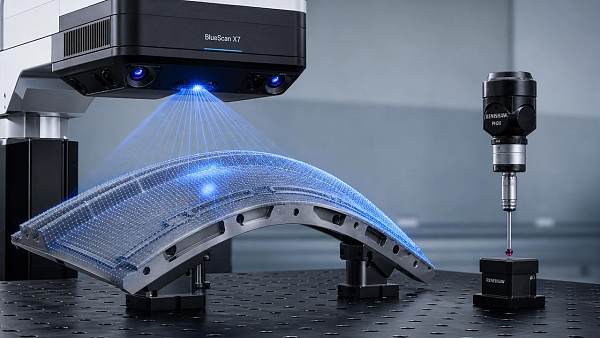
In these cases, Non Contact Inspection can acquire thousands to millions of points in a single pass. Instead of checking 8 to 20 discrete points, an operator can validate an entire surface map and identify local deviations that touch probing may miss.
3. High-throughput production with short takt time
On lines running 200, 500, or 1,000 parts per shift, inspection speed directly affects output. Touch probing often requires slower machine motion, stylus qualification, and repeated part positioning, especially when many features must be sampled.
Non Contact Inspection is often faster because it captures wide areas in one sequence. A vision system may complete dimensional checks in 2 to 10 seconds, while a tactile routine on the same feature set could take 30 to 120 seconds.
The comparison below shows common situations where operators benefit from choosing one method over the other. These are typical manufacturing ranges rather than fixed performance claims, but they provide a practical starting point for method selection.
The key point is not that Non Contact Inspection replaces every tactile method. It wins when the inspection task depends on speed, surface protection, or complete feature visibility rather than just a small number of dimensional points.
4. When operators need better repeatability with less manual influence
Manual probing skill varies by operator, especially across 2 or 3 shifts. Optical and vision-based systems reduce dependence on touch angle, stylus wear, and contact technique. That can improve repeatability in routine checks and simplify training for new users.
Typical operator gains
- Less risk of part damage during loading and inspection
- Faster first-article review on small or complex components
- More complete defect visibility through full-field data
- Easier standardization across multiple stations or plants
How to Decide if Non Contact Inspection Fits Your Process
Choosing the right method should be based on process conditions, not only on instrument preference. Operators and engineering teams should review at least 4 factors: part material, feature type, required tolerance, and inspection takt time.
Material behavior and surface response
If the part bends under light force, has a glossy coating, or includes transparent and reflective zones, system selection becomes more specific. Some optical methods excel on matte metal, while others need controlled lighting, filters, or multi-angle capture for reflective parts.
That does not weaken the case for Non Contact Inspection. It simply means operators should match the sensing method to the surface condition, with setup validation done on real production samples rather than only on drawings.
Tolerance, feature size, and data density
A hole diameter check at ±50 µm is different from a blade profile inspection at ±8 µm. Likewise, a flatness callout over 200 mm requires a different data strategy than a simple edge distance measurement. Non Contact Inspection adds value when more data points improve the decision.
If the defect mode is local waviness, edge chipping, burr formation, or contour drift, a dense scan is usually more informative than 10 discrete tactile touches. This is especially important in process troubleshooting and first-off validation.
Integration with line workflow
An inspection method is only useful if it fits production reality. In many factories, operators need pass/fail output, trend alarms, image records, and recipe switching in less than 15 seconds. Non Contact Inspection supports that workflow more naturally than slow point-by-point routines.
For semi-automated cells, inspection stations can be linked to PLC signals, part ID tracking, or SPC dashboards. This allows faster containment action when drift appears after 20, 50, or 100 parts instead of waiting for end-of-batch review.
The following framework helps operators and supervisors evaluate fit before committing to a method or requesting equipment changes.
This decision model helps prevent a common mistake: comparing technologies only by nominal accuracy while ignoring accessibility, cycle time, and handling risk. For operators, those practical constraints often determine the true measurement outcome.
Best Practices for Operators Using Non Contact Inspection
Getting reliable results from Non Contact Inspection depends on setup discipline. Even advanced systems can produce unstable data if lighting, fixturing, cleanliness, or calibration routines are overlooked.
Control the environment first
Temperature shifts of 2°C to 5°C, airborne dust, vibration from nearby machines, and inconsistent ambient light can all affect results. In high-precision work, stable conditions matter as much as sensor specification.
Operators should check lens cleanliness, part presentation, fixture repeatability, and reference standards at the start of each shift. A 3-minute startup verification can prevent hours of questionable data later.
Use recipe discipline for mixed production
When one station runs 6 to 12 part variants per day, recipe control becomes essential. Store inspection parameters by part number, including exposure, focus range, pass/fail limits, fixture orientation, and output format.
This reduces operator guesswork and improves consistency between shifts. It also shortens changeover time from 10 minutes of manual reset to 1 or 2 minutes of controlled selection in many routine environments.
Validate against known references
Before using Non Contact Inspection for final quality decisions, compare results with certified artifacts, master parts, or established dimensional references. For critical features, cross-checking against a secondary method during the first 20 to 50 production pieces is often a sensible practice.
A simple 5-step operator checklist
- Confirm the correct part recipe and revision level.
- Clean the lens, fixture, and part datum surfaces.
- Run a reference check or calibration verification.
- Inspect the first piece and review image or point-cloud quality.
- Monitor trend alarms and isolate drift before the batch grows.
These controls help Non Contact Inspection deliver its full value: fast measurement without sacrificing traceability or confidence. In regulated or high-spec industries, disciplined operation is what turns a capable sensor into a dependable process tool.
Common Mistakes, Risk Points, and Buying Considerations
Many teams adopt Non Contact Inspection for speed, then become disappointed because they selected the wrong sensing principle or underplanned integration. The method is powerful, but only when the application, workflow, and operating conditions are aligned.
Mistake 1: judging performance by accuracy alone
A quoted accuracy number means little if the part is reflective, translucent, moving, or hard to fixture. Operators need to review not just nominal precision, but also repeatability, sampling speed, sensitivity to surface finish, and ease of use under production pressure.
Mistake 2: ignoring training and service support
Even user-friendly systems need training. A practical onboarding plan usually includes 3 stages: basic operation, recipe editing, and troubleshooting. Without that structure, the station may depend on one expert instead of becoming a stable resource for the whole team.
Mistake 3: underestimating data handling needs
Full-field inspection can generate large datasets. Teams should define whether they need only pass/fail values, image archives for 30 to 90 days, or full traceability tied to lot and serial number. Storage, report format, and network transfer should be planned early.
Before procurement or system upgrade, operators and supervisors can use the checklist below to sharpen requirements and reduce implementation risk.
The strongest purchasing decisions usually come from a line-side perspective. If a system fits the real operator workflow, supports the required tolerance, and handles surface variation without constant adjustment, Non Contact Inspection becomes a practical quality asset rather than a specialized lab tool.
Frequently asked questions from operators
Can Non Contact Inspection replace touch probing completely?
Not always. Touch probing still suits some stable, accessible, and low-point-count measurements. Many factories use both methods, assigning each to the feature types where it performs best.
Is non-contact always faster?
Often yes for complex or full-field checks, but not automatically. Speed depends on loading method, image processing, feature count, and reporting logic. A well-configured station matters as much as the sensor itself.
What is the main warning sign that touch probing is no longer enough?
Repeated issues such as cosmetic marks, missed local defects, long inspection cycles, or frequent program changes for hard-to-reach features usually indicate that Non Contact Inspection should be evaluated.
For operators, engineers, and quality teams, the advantage of Non Contact Inspection becomes clear when the job requires fast, repeatable, and surface-safe measurement across complex parts. It is especially effective where full-field data improves process decisions, where tactile access is poor, and where throughput leaves little room for slow routines.
A sound implementation starts with real sample testing, practical recipe design, and line-ready training rather than specification sheets alone. If your production environment involves delicate surfaces, micro-features, or short takt times, a well-matched non-contact approach can improve inspection consistency and reduce avoidable risk.
To evaluate the right inspection path for your application, contact us for a tailored assessment, discuss your measurement targets, or request a customized solution aligned with your process, tolerance range, and operating workflow.
Recommended News
 Jul 12, 2026How to Vet a Smart Home Devices Wholesale Supplier in ChinaSmart home devices wholesale supplier in China: learn how to verify quality, certifications, lead times, and factory capability before ordering. Avoid costly sourcing risks.
 Jul 08, 2026Vision Inspection Systems Europe: Key Compliance and Performance TrendsVision Inspection Systems Europe is redefining quality control with stronger compliance, traceability, and reliable performance. Explore key trends shaping smarter, audit-ready manufacturing.
 Jul 06, 2026Smart Home Devices Worth Buying for Lower Energy UseSmart home devices can cut energy waste and lower utility bills. Discover the best picks—from thermostats to smart plugs and lighting—to save money with less effort.
 Jun 24, 2026UV Nail Lamps: Key Safety and Curing Factors Before You BuyUVnaillamps buying guide: compare wavelength, wattage, LED layout, and safety features to avoid under-curing, reduce heat spikes, and choose a lamp that delivers reliable salon-like results.
 Jun 23, 2026IP Cameras for Business Security: Resolution, Storage, and Blind SpotsIPcameras for business security: learn how resolution, storage, and blind spot control impact evidence quality, retention, and site coverage before you upgrade.
 Jun 08, 2026Portable Lithium Battery Storage Design: Key Safety and Runtime Trade-OffsLithium battery storage portable design explained: compare safety, runtime, thermal control, and real-world reliability to choose a portable power system that performs with confidence.
 Jun 03, 2026Industrial Hard Hats: What to Check Before Field Deploymentindustrialhardhats must be checked before field deployment. Learn key inspection steps for shell integrity, fit, certification, storage, and traceable safety control.
 Jun 01, 2026Baby Monitors with Camera: Privacy and Safety Features Worth Checkingbabymonitorswithcamera guide: discover key privacy, encryption, app security, night vision, and safety features to choose a smarter baby monitor with confidence.
 May 22, 2026Zero Defect Manufacturing with Vision Inspection: 7 Common MistakesHow to Achieve Zero Defect Manufacturing with Vision Inspection: discover 7 common mistakes, practical fixes, and proven ways to improve quality, traceability, and production confidence.
 May 20, 2026Non Contact Inspection for Fragile Parts: Key TradeoffsNon Contact Inspection for fragile parts: explore the key tradeoffs in accuracy, speed, surface response, and validation to choose a safer, smarter quality strategy.
 May 16, 20263D Profile Projector Factory Comparison for Faster First-Article Inspection3d profile projector factory comparison for faster first-article inspection. Compare image clarity, stage stability, software, calibration, and support to choose a supplier that boosts accuracy and uptime.
 May 12, 2026Non Contact Inspection: When It Beats Touch ProbingNon Contact Inspection beats touch probing when speed, surface protection, and full-field accuracy matter. See when it improves yield, repeatability, and line efficiency.
 May 06, 20263D Profile Projector Factory Checklist for Long-Term Service and Spare Parts3d profile projector factory checklist for long-term service, spare parts, and calibration support. Learn what to verify before buying to reduce downtime and protect uptime.
 May 02, 2026When Non Contact Inspection Makes More Sense Than Touch ProbingNon Contact Inspection makes sense when parts are delicate, geometries are complex, or speed matters. Learn when it outperforms touch probing and supports faster, lower-risk quality decisions.