How to Compare an Electrical Test Equipment Supplier
Time
Click Count
Choosing the right Electrical Test equipment supplier is more than a price decision—it directly affects accuracy, compliance, uptime, and long-term procurement value. For purchasing professionals, comparing suppliers requires a clear view of technical capability, calibration standards, product reliability, after-sales support, and global delivery performance. This guide outlines the key factors that help buyers evaluate suppliers with confidence and reduce sourcing risk in high-precision industrial environments.
Why application context matters when comparing an Electrical Test equipment supplier
A supplier that performs well for general maintenance testing may not be the right fit for aerospace validation, semiconductor labs, EV power electronics, or high-frequency R&D. That is why procurement teams should not compare an Electrical Test equipment supplier only by catalog breadth or initial quotation. The better approach is to begin with the operating scenario: what is being measured, how often it is used, what tolerance is acceptable, which standards apply, and what cost of failure the business can tolerate.
In practical sourcing, the same category of equipment—oscilloscopes, power analyzers, insulation testers, signal generators, digital multimeters, LCR meters, spectrum analyzers, or hipot systems—can support very different business outcomes. In one scenario, the priority is production throughput. In another, it is traceability under ISO/IEC 17025 or alignment with IEEE and NIST practices. In a third, buyers need strong regional support because downtime at a global factory is far more expensive than a higher unit price.
For this reason, comparing an Electrical Test equipment supplier should always be scenario-driven. Buyers who map supplier capabilities to application risk usually make stronger, more defensible purchasing decisions and avoid costly mismatches after installation.
Typical business scenarios where supplier differences become critical
Most procurement evaluations fall into several repeatable use cases. Each one changes what “best supplier” means. Instead of using one checklist for all projects, it is more effective to compare suppliers according to the environment in which the equipment will create value.
This scenario-based comparison helps procurement avoid a common mistake: selecting a supplier that is “strong in general” but weak in the exact operating conditions that matter to the business.
Scenario 1: Production environments need stable supply and predictable performance
In manufacturing plants, especially in electronics, automotive, industrial control, and energy systems, test equipment is part of the throughput engine. Here, an Electrical Test equipment supplier must do more than deliver accurate instruments. The supplier must support fast deployment, repeatable results across shifts, integration with manufacturing execution systems, and rapid replacement when a unit fails.
For this scenario, buyers should focus on operational reliability. Ask whether the supplier offers standardized configurations for multiple production sites, remote diagnostics, user-level permissions, data export compatibility, and preventive maintenance programs. If your line runs across regions, compare stocking strategy and global logistics. A strong supplier should explain lead time by SKU, regional warehouse coverage, and repair turnaround in business days rather than vague commitments.
It is also wise to examine consistency between units. In production testing, instrument-to-instrument variation can create false rejects or hidden escapes. The right Electrical Test equipment supplier should be ready to discuss calibration intervals, guard-banding strategy, and long-term drift characteristics, not just headline specifications from the brochure.
Scenario 2: R&D teams need technical depth, software capability, and upgrade flexibility
The evaluation logic changes in laboratories and design centers. Engineers working on new power devices, communications products, embedded systems, or sensor platforms need insight, not just pass/fail results. In this setting, the best Electrical Test equipment supplier is often the one that combines advanced measurement performance with strong application support.
Procurement should therefore ask broader questions. Can the supplier support waveform analysis, protocol decoding, automated scripting, and data export to the team’s engineering workflow? Does the platform allow future bandwidth or channel upgrades without replacing the full system? Are there software licenses that become expensive over time? How responsive are application engineers when users face a difficult measurement problem?
A lower purchase price can become a poor decision if engineers later need expensive options, third-party accessories, or outside consultants to complete routine work. In R&D, total capability cost matters more than entry price. Buyers comparing an Electrical Test equipment supplier for innovation-heavy teams should include software ecosystem strength, documentation quality, and roadmap transparency in the scorecard.
Scenario 3: Compliance-heavy sectors require traceability, audit readiness, and documentation discipline
If the equipment will support regulated quality systems, supplier comparison must become stricter. This is common in aerospace, medical manufacturing, defense, rail, power infrastructure, and high-reliability electronics. In these environments, the procurement question is not only “Does it measure correctly?” but also “Can we prove it under audit?”
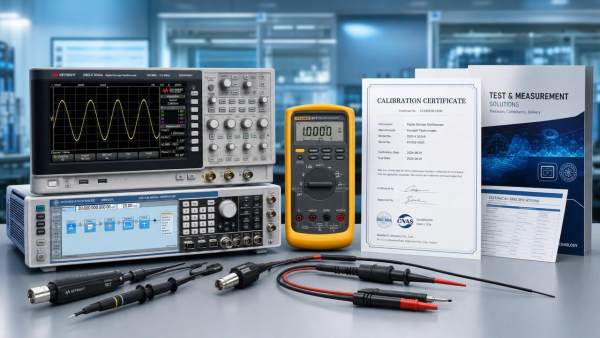
An Electrical Test equipment supplier serving this scenario should provide clear calibration traceability, uncertainty statements when relevant, documentation linked to serial numbers, and formal service records. Buyers should verify whether calibration is performed by accredited laboratories, how recalls or service bulletins are communicated, and whether digital records can be integrated into quality systems.
One useful procurement test is to request sample certificates, sample service reports, and a documented escalation path for nonconformance. Suppliers that cannot present organized documentation early in the process often create friction later when internal auditors, customers, or regulators request evidence.
Scenario 4: Field service operations value portability and local support more than advanced lab features
For utilities, facility management, industrial maintenance, and service contractors, test equipment is used under changing site conditions. Portability, ruggedness, ease of use, and repair access become more important than highly specialized lab functionality. In this context, comparing an Electrical Test equipment supplier requires a practical operational lens.
Ask whether devices are designed for rough handling, outdoor conditions, frequent transport, and technician-friendly interfaces. Review battery endurance, startup time, connector durability, and the availability of protective accessories. Also compare how quickly the supplier can exchange or repair a faulty unit near the point of use. A supplier with excellent headquarters support but weak local infrastructure may not fit field operations well.
Training should also be considered. If the workforce includes mixed skill levels, intuitive operation and short learning curves reduce deployment risk. A capable Electrical Test equipment supplier will often support this scenario with quick-start guides, field application notes, remote troubleshooting, and local language service resources where needed.
How different buyer priorities change the supplier scorecard
The same supplier may score differently depending on who owns the outcome. Procurement, engineering, quality, and operations often value different things. A mature sourcing process makes those differences visible before vendor selection.
This is why a robust Electrical Test equipment supplier comparison should combine technical, operational, and commercial criteria. A single-person decision often misses hidden risk that another function would have identified.
Common misjudgments buyers make in scenario-based supplier selection
One common error is overbuying performance that the application never uses. For example, ultra-high bandwidth, premium analysis software, or specialty options may look impressive, but if the scenario is routine production verification, those features may add cost without measurable value. Another error is underestimating service needs. A low-cost supplier can become expensive if calibration cycles are slow, software support is limited, or downtime disrupts output.
Buyers also sometimes assume compliance is included when it is actually optional. Calibration certificates, accredited services, and extended warranties may be quoted separately. When comparing an Electrical Test equipment supplier, confirm exactly what is included in the base package, what must be renewed annually, and what obligations fall on the user.
A final misjudgment is ignoring supply resilience. In globally distributed operations, availability of replacement units, probes, accessories, and software entitlement support can matter as much as the main instrument itself. Procurement should evaluate the whole support chain, not only the core device.
A practical shortlist method for purchasing teams
To compare suppliers efficiently, start by separating must-have conditions from preference-based criteria. Define the application scenario first, then build the vendor checklist around it. A practical method is to score each Electrical Test equipment supplier across five dimensions: technical fit, calibration and compliance capability, lifecycle support, commercial stability, and global delivery performance.
Next, ask each supplier to respond to the same use-case brief. Include your measurement range, accuracy target, operating environment, expected annual usage, software integration needs, service location, and compliance obligations. Standardized vendor responses make side-by-side comparison more objective. If possible, request a demonstration using your own DUT, workflow, or sample test sequence. Real-world proof reveals gaps that brochures rarely show.
For strategic sourcing, it is also worth reviewing the supplier’s broader technical posture. Organizations such as G-IMS emphasize benchmark-based evaluation because precision industries depend on a chain that extends from hardware performance to actionable measurement intelligence. A supplier that understands both the instrument and the decision environment around it is often better positioned to support long-term industrial value.
FAQ: scenario-focused questions to ask before choosing an Electrical Test equipment supplier
How do I know if a supplier is suitable for high-precision applications?
Review published accuracy, long-term stability, calibration traceability, and application references in industries with similar tolerance demands. Also ask for documentation samples and support structure, not just specifications.
Should price be the main comparison factor?
No. For most industrial buyers, total procurement value includes uptime, service access, software licensing, calibration cost, training, and replacement speed. The cheapest Electrical Test equipment supplier is not always the most economical over the equipment lifecycle.
What matters most for multi-site global operations?
Consistent product configuration, regional inventory, harmonized calibration records, local support coverage, and predictable lead times matter most. Global service capability should be verified with concrete service maps and response commitments.
Final guidance: match the supplier to the scenario, not the brochure
The strongest way to compare an Electrical Test equipment supplier is to start from the business scenario and work backward to the technical and service requirements. Production lines need stability and fast recovery. R&D teams need deep capability and flexible analysis. Compliance-driven operations need traceability and audit-ready documentation. Field teams need rugged tools and local support.
When procurement teams structure evaluation around these differences, supplier selection becomes more accurate, more defensible, and more aligned with operational outcomes. Before issuing the final PO, confirm the real use case, required standards, service geography, software needs, and lifecycle cost model. That is the most reliable path to selecting an Electrical Test equipment supplier that fits your environment today and remains valuable as your testing demands evolve.
Recommended News
 May 03, 2026How to Compare an Electrical Test Equipment SupplierElectrical Test equipment supplier comparison starts with application fit. Learn how to evaluate accuracy, compliance, support, and delivery to reduce risk and choose with confidence.
 May 02, 2026High Frequency Measurement Errors That Distort Real ResultsHigh Frequency Measurement errors can quietly distort critical test results. Learn the main causes, reduce uncertainty, and make smarter validation and procurement decisions.
 Apr 24, 2026Why Spectrum Analyzers Miss Intermittent RF ProblemsSpectrum Analyzers for RF testing can miss intermittent faults. Learn how Electrical Test equipment, NIST Standards for calibration, and smarter capture methods improve RF troubleshooting.
 Apr 24, 2026Electrical Test Errors That Come From Fixture DesignElectrical Test errors often start in fixture design. Learn how Spectrum Analyzers, Industrial Sensors, IEEE Standards, and NIST Standards help improve accuracy, repeatability, and production confidence.