Environmental Monitoring Sensors That Drift Too Fast
Time
Click Count
When Environmental Monitoring sensors drift too fast, data integrity, compliance, and process stability all come under pressure. For researchers and operators comparing advanced metrology solutions, Electrical Test equipment, and 3D Scanning for quality control, understanding drift is essential. This article explains the causes, warning signs, and calibration strategies aligned with NIST Standards for calibration to help teams protect measurement confidence and avoid costly decisions.
In high-value industrial and laboratory environments, sensor drift is rarely a minor maintenance issue. A humidity probe that shifts by 2% RH, a particulate sensor that slowly loses linearity, or a gas sensor with an unstable zero point can influence process qualification, storage conditions, cleanroom behavior, and audit readiness. For B2B buyers and front-line operators, the challenge is not only detecting drift, but also deciding when recalibration, replacement, or redesign is the right response.
Within the broader ecosystem of intelligent measurement, environmental monitoring sensors sit close to production risk. Their outputs often feed quality systems, alarm thresholds, and traceability records used alongside 3D scanning, optical inspection, and electrical test workflows. If the environmental layer becomes unreliable, downstream decisions become harder to defend, especially in regulated sectors where tolerances, calibration intervals, and documented corrective action matter.
Why Fast Sensor Drift Matters in Industrial Measurement Environments
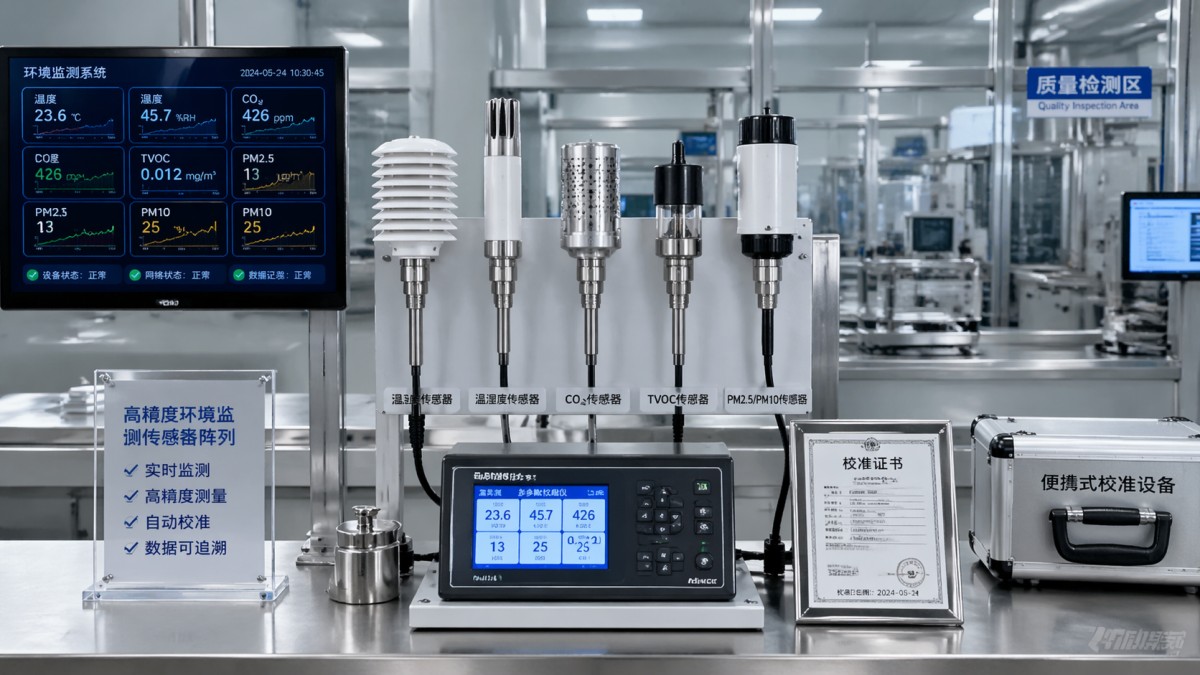
Fast drift means a sensor’s output changes over time even when the real-world condition remains stable. In practice, this may show up as a temperature sensor reading 0.4°C high after 90 days, a volatile organic compound detector requiring more frequent zeroing, or a dew point instrument deviating outside its published tolerance before the next service window. In tightly controlled facilities, even a small trend can distort compliance records and process interpretation.
The impact is amplified in sectors where environmental values affect product quality indirectly. Semiconductor packaging, aerospace bonding, battery assembly, electronics storage, and calibration laboratories all depend on stable conditions such as 20°C to 23°C, 40% to 60% RH, or tightly controlled particle levels. If drift is not identified early, operators may blame process equipment, materials, or personnel while the actual issue sits in the monitoring layer.
For information researchers evaluating equipment, the important point is that sensor drift affects more than the sensor itself. It affects confidence in every action built on that reading, including preventive maintenance triggers, quarantine decisions, acceptance testing, and environmental trend analysis over 6 to 12 months. That is why procurement teams increasingly review long-term stability, calibration burden, and traceability support rather than only headline accuracy at shipment.
In a mixed measurement environment, environmental monitoring often supports other precision systems. A 3D scanner, CMM, vision inspection cell, or electrical test station may perform within specification only if ambient conditions remain inside defined bands. A drifting temperature or humidity channel can therefore create hidden uncertainty in dimensional inspection, optical contrast stability, or high-frequency test repeatability, even when the primary instrument appears healthy.
Typical operational consequences
- False alarms that increase operator intervention frequency from once per month to once per week.
- Missed excursions where actual conditions exceed internal limits for 2 to 8 hours without trustworthy detection.
- Audit exposure when calibration certificates remain valid on paper, but field behavior no longer matches expected stability.
- Higher lifecycle cost because sensors need replacement every 12 months instead of a planned 24 to 36 months.
Main Causes of Environmental Monitoring Sensors Drifting Too Fast
Drift usually results from a combination of material aging, contamination, thermal stress, exposure profile, and installation quality. Not all drift is a product defect. Some sensors degrade faster because the application is harsher than the original specification assumed. For example, repeated condensation cycles, solvent exposure, sulfur compounds, or fine dust loading can alter response characteristics far earlier than a standard indoor monitoring profile would suggest.
Electrochemical gas sensors may show baseline shift after continuous exposure near the upper end of their operating range. Optical particle counters can lose consistency when optics become contaminated. Humidity sensors can drift due to polymer aging or chemical poisoning. Temperature probes may remain accurate in the lab but shift in the field because of cable stress, poor shielding, or repeated thermal cycling between 5°C and 45°C. The point is to evaluate the full system, not the sensing element alone.
Another major cause is mismatch between calibration interval and actual usage intensity. A sensor calibrated every 12 months may be acceptable in an office-grade environment, yet inadequate in a production zone with vibration, washdown, airborne chemicals, or 24/7 duty cycles. The more dynamic the environment, the more important it becomes to align maintenance planning with exposure severity rather than calendar convention.
Fast drift can also originate from installation and signal-chain problems. Poor airflow placement, radiant heat from nearby equipment, improper warm-up, unstable power supply, or signal conversion errors can look like sensor instability. In networked systems, analog-to-digital conversion, gateway scaling, and firmware compensation can each add a layer of offset or nonlinearity that operators mistakenly attribute to the sensor head.
Cause categories that should be verified first
The table below helps operators and technical buyers separate intrinsic sensor aging from environmental and integration-related causes. This distinction often determines whether recalibration is enough or whether application redesign is required.
A practical takeaway is that drift should be investigated at three levels: sensing element, installation environment, and data path. Teams that skip one of these levels often replace hardware unnecessarily or continue operating with unresolved measurement bias.
A common selection mistake
One frequent procurement mistake is choosing based on initial accuracy alone, such as ±0.2°C or ±2% RH, without reviewing long-term stability specifications like annual drift, recommended recalibration interval, recovery time, and exposure exclusions. For industrial decision-makers, these stability metrics are often more valuable than a narrow brochure accuracy statement.
How to Detect Drift Before It Damages Data Integrity
Early detection depends on trend discipline, reference comparison, and alarm logic that distinguishes true environmental change from measurement instability. Operators should not wait until a formal calibration failure occurs. In many facilities, the first warning sign appears as recurring deviation between neighboring sensors, longer recovery after a process upset, or unexplained shifts in monthly baseline values.
A practical monitoring strategy includes periodic side-by-side comparison against a traceable portable reference. For critical points, monthly or quarterly checks are common even when accredited calibration is scheduled every 6 or 12 months. This intermediate verification creates a decision layer between normal operation and full service intervention, helping teams catch drift while maintaining production continuity.
Data historians also matter. If the software platform stores only alarm events and not raw trend data, subtle drift may remain invisible. Capturing 1-minute, 5-minute, or 15-minute interval data allows analysts to detect baseline creep, increased noise, or changing response slope. In multi-sensor zones, comparative analytics can flag a single suspect device when three other channels remain stable under the same environmental load.
For operators, the key is to define numeric triggers. Without thresholds, drift discussions become subjective. A site may, for example, investigate any offset greater than 0.3°C, 3% RH, 10% of gas span, or a particle trend deviation beyond an internally accepted variance band. The exact threshold depends on process sensitivity, but documented criteria improve consistency across shifts and departments.
Field warning signs worth documenting
- A sensor that requires repeated manual adjustment more than 2 times within a single quarter.
- Neighboring sensors in the same zone showing persistent differences beyond the local acceptance limit.
- Longer stabilization time after startup, cleaning, or a step change in temperature or humidity.
- Readings that correlate more strongly with equipment heat load than with independent reference measurements.
A practical drift screening matrix
The following matrix can support triage decisions before sending every sensor for immediate calibration. It is especially useful where dozens or hundreds of channels are installed across production, storage, and validation areas.
This kind of structured screening reduces unnecessary downtime and helps separate one-time adjustment needs from systemic instability. It also gives procurement teams evidence when evaluating whether a different sensor technology or service model is justified.
Calibration Strategy and NIST-Aligned Control Measures
A strong calibration strategy should do more than satisfy a certificate requirement. It should define how reference standards are selected, how many calibration points are used, what environmental conditions apply during calibration, and how as-found versus as-left data are reviewed. For operations linked to NIST-traceable practices, the goal is defensible measurement confidence rather than paperwork alone.
In many industrial programs, a 3-step logic works well: routine verification in the field, scheduled accredited calibration, and event-based calibration after exposure incidents. A sensor exposed to condensate, solvent splash, shock, or power anomaly may need immediate evaluation even if its annual interval has not expired. This is especially relevant for environmental channels supporting cleanrooms, metrology rooms, and controlled storage.
Calibration intervals should reflect process criticality. A non-critical warehouse channel may be reviewed every 12 months, while a clean process area or dimensional inspection room may justify 3-month or 6-month verification cycles. The highest-risk points are not always those with the most expensive sensors. They are the points where an inaccurate value can trigger incorrect release, reject, or process compensation decisions.
It is also important to document guard bands. If a process limit is tight, a site may choose an internal action threshold that sits 10% to 20% inside the formal limit to account for uncertainty and drift between calibration points. This approach is widely useful where environmental readings influence product qualification or measurement correction factors.
Recommended control workflow
- Define each sensor’s role: informational, alarm-based, or quality-critical.
- Assign an initial verification interval of 30, 90, 180, or 365 days based on risk.
- Use a traceable reference at 2 to 5 points across the normal operating range.
- Review as-found drift trend over at least 2 consecutive service cycles.
- Adjust interval, replace technology, or improve installation if drift exceeds expectation.
What buyers should request from suppliers
When sourcing environmental monitoring sensors, buyers should request long-term stability specifications, recommended field verification methods, service turnaround expectations, and calibration traceability details. A supplier that can explain uncertainty, reference conditions, and recalibration methodology usually offers stronger lifecycle support than one focused only on catalog performance claims.
For multi-site organizations, standardizing calibration policy across facilities can reduce confusion. Common templates for acceptance limits, reference equipment requirements, and out-of-tolerance response plans help quality teams compare sensor performance consistently from one plant or lab to another.
How to Select Sensors That Hold Stability Longer
Selecting for stability means looking beyond brochure sensitivity. Operators and technical specifiers should evaluate sensor technology type, environmental sealing, contamination resistance, field replaceable parts, response time, warm-up behavior, and stated annual drift. In many applications, a slightly higher upfront cost is justified if it cuts recalibration frequency, false alarms, and unplanned replacements over a 24- to 36-month ownership period.
The best sensor is application-specific. For example, an indoor comfort-grade humidity sensor may not survive a production area with repeated washdowns or solvent traces. A gas sensor designed for intermittent exposure may not hold baseline stability under continuous load. A particle monitoring device with high sensitivity may still underperform if maintenance access is poor and optical cleaning is frequently delayed.
Selection should also account for how the sensor integrates with the broader measurement stack. Output format, digital diagnostics, local display, calibration memory, and alarm handling all affect usability. In advanced facilities, environmental channels increasingly feed centralized analytics, where health indicators such as self-diagnostics, drift flags, and service counters are as valuable as the measured variable itself.
For procurement teams under budget pressure, lifecycle comparison is often more revealing than purchase price comparison. A lower-cost unit that needs quarterly intervention may create more labor, downtime, and audit burden than a more stable unit with a longer field verification cycle and better contamination tolerance.
Selection factors by evaluation priority
The table below summarizes practical criteria for comparing environmental monitoring sensors in industrial and controlled environments.
The main conclusion is that stable sensors are usually the result of correct technology fit, not simply premium branding. Buyers should compare published stability, service support, and environmental compatibility in the context of their actual operating profile.
Implementation, Maintenance, and FAQ for Operators and Researchers
Once a sensor platform is selected, implementation quality determines whether its stability potential is realized. Proper placement away from radiant heat, direct drafts, splash zones, and electrical noise is essential. So is a defined maintenance plan covering cleaning, filter checks, zero checks where relevant, firmware review, and service records. Even a robust instrument can appear unstable if field handling is inconsistent across shifts or facilities.
For larger deployments, operators benefit from grouping sensors by criticality and service class. A simple three-tier system often works well: Tier 1 for quality-critical points, Tier 2 for process-support points, and Tier 3 for general awareness points. This avoids over-servicing low-risk channels while protecting metrology rooms, validation zones, and high-value storage environments with tighter control.
Researchers comparing vendors should also ask how drift information is presented after service. A certificate alone is useful, but trend-based service reporting is more actionable. Seeing two or three calibration cycles side by side helps determine whether a sensor family is aging predictably or becoming a maintenance outlier across the installed base.
At the organizational level, the most resilient programs combine procurement discipline, calibration traceability, and operator training. When these three elements are aligned, environmental data becomes a reliable decision input for quality control, advanced inspection, and broader intelligent measurement workflows.
FAQ: How often should environmental sensors be verified?
A common starting point is every 3, 6, or 12 months depending on process impact. Critical areas such as metrology labs, clean manufacturing cells, or controlled storage may justify monthly spot checks plus annual accredited calibration. Non-critical areas may operate safely with longer cycles if drift history remains stable.
FAQ: When is recalibration not enough?
If a sensor repeatedly returns out of tolerance, shows unstable response after recalibration, or drifts too quickly within 30 to 90 days, recalibration alone may not solve the problem. The root cause could be contamination, wrong technology selection, placement error, or an application that exceeds the intended exposure profile.
FAQ: Which records should operators keep?
At minimum, keep installation date, service interval, as-found and as-left values, reference equipment used, environmental conditions during calibration, and any corrective action taken. For high-value operations, trend history over 12 to 24 months provides strong evidence for interval adjustment and procurement improvement.
FAQ: What is the most overlooked risk during procurement?
The most overlooked risk is assuming that initial accuracy equals long-term reliability. In reality, annual drift, contamination resilience, service turnaround, and diagnostic visibility often have greater influence on total cost of ownership and data confidence than the initial specification sheet.
Environmental monitoring sensors that drift too fast create a chain reaction: weaker data integrity, higher compliance exposure, and less confidence in every process decision tied to ambient conditions. For operators, the right response is early detection, numeric action limits, and disciplined verification. For researchers and procurement teams, the smarter path is to compare stability, calibration support, and field fit rather than focusing only on upfront accuracy or price.
G-IMS supports this decision process by framing environmental monitoring within the broader context of industrial measurement, quality control, and traceable performance benchmarking. If you need help evaluating sensor drift risk, comparing calibration strategies, or identifying a better-fit monitoring architecture for controlled environments, contact us now to discuss your application, request a tailored recommendation, or learn more about advanced measurement solutions.
Recommended News
 May 15, 2026Specialized Sensors for High-Temperature Applications ComparedSpecialized Sensors for High-Temperature Applications compared: explore thermocouples, RTDs, infrared, and fiber optic options to improve accuracy, reliability, and process control.
 May 04, 2026Specialized Sensors for High-Temperature Applications: What Reduces DowntimeSpecialized Sensors for High-Temperature Applications help cut downtime in furnaces, turbines, and process lines with better stability, faster fault detection, and longer service life.
 Apr 24, 2026Environmental Monitoring Sensors That Drift Too FastEnvironmental Monitoring sensors drifting too fast can compromise compliance and quality. Learn how Electrical Test equipment, 3D Scanning for quality control, and NIST Standards for calibration help reduce risk.
 Apr 24, 2026Industrial Sensors That Fail Early in High Humidity SettingsIndustrial Sensors in high humidity can drift, corrode, and fail early. Explore 3D Scanning, Spectrum Analyzers, Electrical Test, Hyperspectral Imaging, CMM, and IEEE/NIST-based selection tips.