How to Choose Digital Calipers for Repeatable Accuracy
Time
Click Count
Choosing digitalcalipers for repeatable accuracy starts with a simple correction: resolution is not the same as dependable measurement. A display that reads 0.01 mm can still produce unstable results if the jaws flex, the slider drifts, or the instrument reacts poorly to shop-floor conditions.
That distinction matters across general industry, from machining and electronics assembly to incoming inspection, fixture setup, maintenance, and lab support. In each setting, digitalcalipers often sit between quick screening tools and higher-end metrology systems, which makes their consistency more important than their price suggests.
A practical evaluation also fits the broader G-IMS view of measurement: useful data must lead to reliable action. When measurement hardware, calibration discipline, and data integrity align, digitalcalipers support faster decisions with less variation and stronger traceability.
What repeatable accuracy really means
Repeatable accuracy is the ability to obtain the same result, within a controlled tolerance band, when the same feature is measured multiple times. For digitalcalipers, this depends on mechanics, electronics, operator technique, and the part itself.
In real use, three terms are often confused. Resolution is the smallest displayed increment. Accuracy is closeness to the true value. Repeatability is the consistency of repeated readings. A sound buying decision weighs all three, but repeatability usually determines daily usefulness.
This is why two digitalcalipers with similar catalog claims can behave very differently in production. One may hold stable readings across operators and shifts. The other may wander enough to create false rejects, rework, or unnecessary escalation to a CMM.
Why the market is paying closer attention
Tolerances are tightening in many sectors, yet inspection time is under pressure. That combination raises the value of portable instruments that are fast, traceable, and trustworthy. Digitalcalipers remain widely used because they balance speed, flexibility, and cost.
At the same time, quality systems now expect stronger evidence. Measurement records may feed SPC software, supplier audits, first-article reviews, or compliance files. If digitalcalipers cannot deliver consistent readings and reliable output, the weakness spreads beyond one workstation.
From a benchmarking perspective, this is also where G-IMS places emphasis. The question is not whether a tool can measure once under ideal conditions. The better question is whether it supports repeatable, defensible decisions under actual operating constraints.
The specifications that deserve more scrutiny
Jaw geometry and measuring faces
Jaw flatness, parallelism, and edge quality strongly affect contact consistency. Poorly finished measuring faces can tilt on the part, especially on thin walls, narrow lands, and small diameters. That creates variation even when the display appears precise.
Depth rods and step-measurement surfaces also deserve inspection. Many errors in digitalcalipers come from secondary features rather than the main outside jaws. If those surfaces are not rigid and square, repeatability drops quickly.
Beam rigidity and slider feel
A caliper that twists easily will not measure consistently across different hand pressures. Smooth motion matters, but so does controlled friction. Excessive looseness can cause position shift. Excessive drag encourages variable measuring force.
For digitalcalipers used near tolerance limits, tactile stability often predicts field performance better than headline resolution. A rigid beam and well-fitted carriage usually reduce variation more effectively than an extra decimal place.
Accuracy statement and measurement range
Accuracy claims should be read with the full range in mind. Some digitalcalipers perform acceptably near the lower end but degrade toward full extension. Long-range models are useful, but they need stronger mechanical design and better verification routines.
It is also worth checking whether the manufacturer states accuracy by range segment, temperature reference, or standard condition. Vague specifications often hide important limits.
Calibration traceability is part of performance
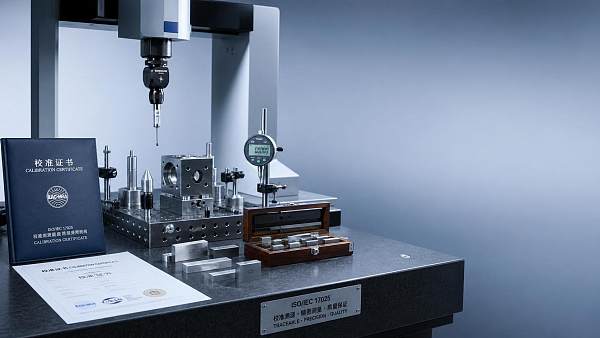
A digital tool without credible traceability may still be useful for rough comparison, but it is harder to defend in controlled workflows. For repeatable accuracy, calibration should link to recognized standards and documented intervals, not just a factory label.
In many operations, the stronger approach is to review digitalcalipers together with the calibration process. That includes zero verification, block checks across the operating range, records of adjustment, and environmental notes.
A short checklist helps separate convenience claims from disciplined measurement practice:
- Traceability to ISO/IEC 17025-supported calibration workflows or equivalent accredited methods.
- Documented inspection points across the measuring range, not only at zero.
- Clear uncertainty information for the calibration result.
- Defined recalibration intervals based on usage frequency and risk.
- Records that connect instrument ID, operator use, and quality events.
Environmental tolerance changes the result
Digitalcalipers are often used outside ideal metrology rooms. Coolants, oil films, dust, thermal gradients, and electromagnetic noise can all affect readings or handling. A model that performs well on a clean bench may be less reliable near machines.
Ingress protection, battery stability, and display readability become practical quality factors. If the tool must survive frequent wiping, glove use, and transport between stations, durability is directly related to repeatability.
Temperature deserves special attention. Measuring a warm part with room-temperature digitalcalipers can create error even when the instrument is functioning correctly. In such cases, the issue is not poor hardware alone but poor measurement context.
Data output is no longer a minor feature
For many workflows, digitalcalipers are not isolated hand tools. They feed inspection databases, MES layers, or spreadsheets that become formal records. In that environment, output stability matters almost as much as dimensional stability.
Check whether the instrument exports data cleanly, with dependable timing and low risk of transcription errors. Wired and wireless options both have value, but the right choice depends on interference exposure, cybersecurity policy, and record-keeping discipline.
A useful question is whether the digitalcalipers improve process control or merely digitize a manual habit. If data capture is slow, inconsistent, or difficult to validate, the benefit may be smaller than expected.
Matching digitalcalipers to the task
No single model fits every inspection need. The best choice depends on feature size, material condition, access, throughput, and the consequence of a wrong reading. A narrow tolerance on a soft component calls for different priorities than a quick warehouse verification.
Typical matching logic looks like this:
- For incoming inspection, prioritize traceability, range coverage, and easy verification against masters.
- For production checks, prioritize robustness, repeatability under speed, and stable zero retention.
- For electronics or fine components, prioritize jaw geometry, low measuring force, and display clarity.
- For digital records, prioritize output compatibility and low-error transfer methods.
Where tolerances approach the practical limit of caliper measurement, escalation rules are important. Digitalcalipers should not be forced into roles better served by micrometers, bore gauges, vision systems, or CMM inspection.
A more defensible evaluation process
The strongest selection process combines specification review with hands-on trials. Measure representative parts, not only gauge blocks. Compare repeated readings across users. Check performance at different jaw openings. Review data output under real workflow conditions.
This aligns with the G-IMS approach to technical benchmarking: instruments should be judged by how they perform inside a controlled decision framework, not by isolated brochure language. Measured repeatability, environmental fit, and traceable calibration together reveal the true value of digitalcalipers.
A practical next step is to build a short comparison matrix before purchase or replacement. Include mechanical stability, calibration evidence, environmental suitability, output reliability, and application fit. That method usually leads to better digitalcalipers decisions than comparing price and resolution alone.
Recommended News
 Sep 18, 2026How to evaluate quality control at a CNC machining factoryEvaluate a CNC machining factory with practical checks for inspection, calibration, traceability, sampling, and corrective actions to secure reliable parts.
 Sep 17, 2026How to select inline measurement systems for Middle East heatInline Measurement Systems Middle East: learn how to select reliable solutions for heat, dust, vibration, calibration, and production-ready data integration.
 Sep 16, 2026How to choose monitor stands that reduce neck strain at workMonitor stands can reduce neck strain by improving screen height, distance, and stability. Explore practical tips to choose the right ergonomic stand for a more comfortable workspace.
 Sep 15, 2026How to verify an importers directory for machinery before contacting suppliersImporters directory for machinery verification guide: assess legal status, technical fit, compliance, and service capability to build a reliable supplier shortlist.
 Sep 13, 2026How to assess calibration support from metrology suppliers in the Middle EastMetrology suppliers Middle East: learn how to assess ISO/IEC 17025 scope, calibration uncertainty, local support, turnaround time, and lifecycle cost.
 Sep 12, 2026How material fatigue causes cracks in safety-critical componentsMaterial fatigue can trigger hidden cracks in safety-critical components long before visible failure. Learn how cyclic loading, stress concentrations, inspection methods, and targeted controls reduce risk.
 Sep 10, 2026What to verify before choosing an optical micrometer supplier for wireChoose an optical micrometer supplier for wire with confidence. Verify real-line accuracy, calibration, integration, and support before you buy.
 Sep 08, 2026How to choose thickness gauges for pipes with limited accessThickness Gauges for pipes: learn how to select the right ultrasonic gauge and probe for tight access, curved surfaces, corrosion, coatings, and reliable readings.
 Sep 07, 2026How to choose anti-aging face serums for your skin typeantiagingfaceserums made simple: discover the best ingredients, textures, and routines for dry, oily, sensitive, or combination skin—plus tips for visible results.
 Sep 05, 2026How to choose sheet metal components for tight-tolerance assembliesSheet metal components for tight-tolerance assemblies: learn how to align materials, datums, forming, finishes, and inspection for reliable fit and repeatable performance.
 Sep 04, 2026What accuracy should a digital temperature humidity sensor have?Digital temperature humidity sensor accuracy explained: compare temperature and RH limits, resolution, drift, calibration, and installation effects to choose reliable performance for your application.
 Sep 03, 2026How to choose glamping tents for eco resorts in high-wind locationsGlamping Tents for eco resorts: discover how to choose wind-resistant structures, engineered anchors, and durable materials for safer, sustainable stays.
 Sep 02, 2026How to assess a bore gauge manufacturer in Latin America for measurement reliabilityBore gauge manufacturer Latin America: learn how to verify calibration traceability, repeatability, service support, and shop-floor reliability before you buy.
 Sep 01, 2026What accuracy factors matter most in advanced metrology calibration?Advanced metrology calibration: discover the key accuracy factors—from traceability and uncertainty to environment, probes, and software—for reliable decisions.
 Aug 31, 2026When does legal tech make sense for a growing business?Legal tech helps growing businesses streamline contracts, compliance, IP, and audit controls. Discover the key signals, practical tools, and steps to scale with confidence.
 Aug 30, 2026How manufacturing tolerance affects thread gauge acceptance limitsThread gauge manufacturing tolerance affects acceptance limits, calibration confidence, wear risk, and inspection consistency. Learn how to prevent costly thread gauge errors.
 Aug 29, 2026How to choose office supplies that reduce waste in shared workspacesOffice supplies can cut waste and costs in shared workspaces. Discover practical procurement tips for durable, refillable, low-packaging products.
 Aug 28, 2026How to compare metrology equipment vendors for calibration supportMetrology equipment vendors: compare calibration scope, ISO/IEC 17025 support, downtime, documentation, and lifecycle costs to choose reliable service.
 Aug 27, 2026What to evaluate before choosing industrial inspection systems in AsiaIndustrial Inspection Systems Asia: evaluate accuracy, cycle time, automation, traceability, and local service to choose a reliable solution for smarter quality control.
 Aug 26, 2026Do dermarollers actually improve absorption of skincare productsDermarollers can improve skincare absorption, but not always safely. Learn when they help, which products to pair, and how to avoid irritation for better skin results.
 Aug 25, 2026What makes a high accuracy CMM probe reliable at tight tolerancesHigh accuracy CMM probe reliability depends on repeatability, stylus stability, calibration integrity, and system fit. Learn what ensures trusted results at tight tolerances.
 Aug 24, 2026When does an automated trade platform make sense for growing teams?Automated trade platform adoption makes sense when growing teams face supplier complexity, compliance risk, and limited visibility. Learn the signs, ROI factors, and how to scale with control.
 Aug 22, 2026How to vet an industrial measurement equipment supplier for calibration traceabilityIndustrial measurement equipment supplier selection starts with calibration traceability. Learn how to verify ISO/IEC 17025 evidence, uncertainty, and audit-ready documentation.
 Aug 20, 2026What is driving demand in the optical metrology market right nowOptical metrology market demand is rising as manufacturers need faster, non-contact, high-precision inspection for semiconductors, EVs, electronics, and automated production lines.