Aerospace Measurement Challenges That Standard QA Often Misses
Time
Click Count
In aerospace manufacturing, standard QA routines often fail to detect the hidden variables that compromise safety, compliance, and long-term performance. Aerospace Measurement requires far more than routine inspection—it demands sub-micron accuracy, traceable data, and intelligent validation across complex materials, geometries, and operating conditions. This article explores the overlooked measurement challenges that quality and safety leaders cannot afford to ignore.
Why standard QA misses critical Aerospace Measurement risks
Many quality teams assume that a compliant inspection plan is enough to control aerospace risk. In practice, conventional QA often focuses on pass/fail checks at predefined points, while the real failure mechanisms emerge between those checkpoints. Aerospace Measurement is not only about verifying dimensions. It is also about detecting drift, instability, material behavior, alignment error, environmental influence, and data traceability gaps before they become flight-critical issues.
This challenge is especially important for quality managers and safety leaders dealing with multilayer supply chains, mixed-material assemblies, and strict certification expectations. A part may pass incoming inspection and still carry hidden geometric deviation, thermal response inconsistency, or surface condition anomalies that standard gauges never reveal. In aerospace, those missed variables do not stay in the metrology lab. They affect assembly fit, fatigue life, vibration behavior, sealing performance, and regulatory confidence.
- Routine QA often checks static dimensions but misses dynamic behavior under heat, load, or pressure.
- Sampling plans may overlook local defects on complex surfaces, thin walls, bonded interfaces, or internal channels.
- Measurement systems may be calibrated, yet still unsuitable for the required uncertainty budget of a specific aerospace feature.
- Data may exist in separate systems without a traceable chain linking sensor output, process variation, and final release decisions.
For this reason, Aerospace Measurement should be treated as a decision infrastructure rather than a final inspection activity. That is where a benchmark-driven approach becomes valuable. G-IMS supports industrial teams by connecting advanced metrology, optics, non-contact inspection, electrical testing, and environmental sensing into a more actionable quality framework aligned with ISO/IEC 17025, IEEE references, and NIST-traceable logic.
Which Aerospace Measurement challenges are most commonly underestimated?
The most expensive measurement failures are usually not dramatic. They are subtle, repeatable, and easy to normalize inside a busy production environment. Quality leaders often encounter them when a line shows inconsistent yield, a customer questions traceability, or assembly teams report unexplained fit-up problems despite acceptable inspection records.
1. Complex geometry creates blind spots
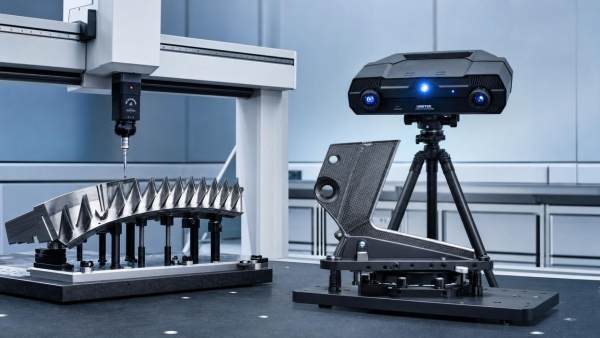
Aerospace components rarely have simple prismatic shapes. Turbine blades, structural ribs, composite skins, housings, and machined pockets include freeform surfaces, hidden features, and tight datum relationships. Standard contact measurement may capture selected points but miss profile distortion, edge transitions, or local curvature deviations. A part can appear acceptable while still introducing aerodynamic inefficiency or assembly stress.
2. Material behavior changes the measurement result
Titanium, nickel alloys, carbon fiber composites, and bonded hybrid structures respond differently to temperature, humidity, clamping force, and probe interaction. Aerospace Measurement must account for expansion coefficients, surface reflectivity, anisotropy, and elastic deformation. If the method ignores material behavior, the reported value may be repeatable but still wrong for the real operating condition.
3. Environmental variables distort confidence
Many factories calibrate instruments on schedule yet underestimate room vibration, airborne contamination, thermal gradients, and lighting variability. In high-precision Aerospace Measurement, these factors influence both contact and optical systems. A stable machine in an unstable environment creates false confidence, especially when measurement results are close to tolerance boundaries.
4. Traceability stops at the instrument, not the decision
A certificate of calibration is necessary, but it does not prove that the entire measurement decision chain is robust. Quality teams also need traceability for fixtures, software versions, operator methods, environmental compensation logic, and data interpretation thresholds. Without this, audits become difficult and root-cause analysis becomes slow.
5. Standard QA overlooks correlation across systems
Dimensional inspection, surface analysis, electrical test, leak detection, and environmental sensing are often managed independently. Aerospace defects, however, may emerge from interaction across domains. A bonded assembly can show acceptable dimensions but fail later because humidity exposure changed adhesion behavior. A connector can pass electrical checks yet have positional deviation that causes installation stress. Cross-domain correlation is a core requirement in advanced Aerospace Measurement.
Where routine inspection breaks down in aerospace production
The following scenarios show where standard QA methods often lose resolution. These examples are relevant for procurement teams selecting inspection systems as well as for safety managers reviewing process risk.
This Aerospace Measurement scenario table helps clarify why different parts and production stages require different sensing logic rather than one general-purpose inspection tool.
The pattern is clear: routine inspection usually validates a limited set of visible criteria, while Aerospace Measurement must verify the relationship between geometry, material condition, process stability, and use-case stress. That difference is why many nonconformities are discovered late, after value has already been added to the part.
How quality and safety teams should evaluate Aerospace Measurement capability
When selecting systems or reviewing existing inspection plans, teams should stop asking only whether an instrument can measure a feature. The better question is whether the full measurement workflow can support a defensible release decision at the required level of risk. This is especially important when supplier variability, production speed, and compliance audits all pressure the same organization.
Key evaluation criteria
- Measurement uncertainty matched to tolerance, not just instrument brochure resolution.
- Capability across reflective, dark, curved, composite, and thin-wall surfaces common in aerospace programs.
- Data traceability from sensor acquisition through software processing to quality decision records.
- Environmental compensation strategy for temperature, vibration, contamination, and illumination changes.
- Integration with SPC, MES, digital twin, or supplier quality systems for faster root-cause response.
- Validation support aligned with ISO/IEC 17025 practices and recognized traceability expectations.
G-IMS is especially relevant in this evaluation phase because it benchmarks technologies across five industrial pillars rather than treating metrology as an isolated purchase. For aerospace organizations, that multidisciplinary view reduces the risk of buying a high-end device that cannot connect to process intelligence, environmental controls, or adjacent testing requirements.
Aerospace Measurement technology comparison for procurement decisions
No single method covers every aerospace requirement. Procurement teams need to compare systems based on part geometry, throughput, surface behavior, traceability needs, and operator skill. The table below summarizes where common approaches fit and where hidden limitations appear in Aerospace Measurement programs.
For many aerospace sites, the right answer is a layered architecture rather than a single-platform purchase. CMMs may anchor traceable dimensional control, while 3D scanning accelerates profile analysis and environmental sensors protect data quality. G-IMS helps teams compare these options through a technical benchmarking lens rather than a purely sales-driven specification sheet.
What standards and compliance teams should check beyond calibration
Compliance in Aerospace Measurement extends beyond whether an instrument has been calibrated. Safety managers and auditors increasingly look for a repeatable method, controlled environment, software governance, operator competence, and uncertainty awareness. A system can be calibrated yet still produce weak evidence if the surrounding process is not validated.
Core compliance checkpoints
- Traceability path: confirm reference standards, interval logic, and linkage to recognized frameworks such as NIST-traceable references where applicable.
- Method validation: verify the inspection method for the actual feature type, material condition, and tolerance stack, not just for a generic part family.
- Uncertainty analysis: define whether decision rules account for measurement uncertainty near specification limits.
- Software and data integrity: maintain revision control, access discipline, result storage logic, and audit-ready reporting.
- Environmental monitoring: document temperature, humidity, vibration, and contamination controls when they materially affect results.
Organizations using G-IMS insights can align sourcing and validation discussions with these checkpoints earlier in the procurement cycle. That reduces late-stage surprises such as missing documentation, incompatible reporting formats, or a system that performs well in demos but poorly in audited production conditions.
Common Aerospace Measurement mistakes that increase safety and cost exposure
Even experienced teams can make avoidable mistakes when timelines are tight and customer requirements are changing. These errors usually appear reasonable in the short term but create larger cost and compliance risks later.
- Using instrument resolution as a substitute for proven measurement uncertainty in a real part environment.
- Approving one universal inspection method for metal, composite, coated, and bonded parts without method-specific validation.
- Treating environmental monitoring as optional because it does not directly generate dimensional data.
- Buying high-speed inspection tools without confirming data interoperability with quality management or process control systems.
- Delaying correlation studies between contact and non-contact methods until customer issues or audit findings force rework.
The financial impact of these mistakes is broader than scrap. It includes delayed first article approval, additional containment activity, supplier disputes, engineering review hours, and slower release decisions. For safety-critical programs, weak Aerospace Measurement also damages confidence across the organization because teams can no longer separate true process variation from measurement noise.
FAQ: practical questions quality leaders ask about Aerospace Measurement
How do we know if our current Aerospace Measurement system is good enough?
Start with decision risk, not equipment age. Review whether the system can achieve a defensible uncertainty level for your tightest tolerances, maintain consistency across operators and shifts, and preserve traceable data for audits. If recurring disputes appear between production, quality, and customer results, your current system may be producing data without sufficient decision confidence.
Is non-contact inspection always better for aerospace parts?
Not always. Non-contact methods are valuable for fragile surfaces, freeform geometry, and faster coverage, but they also depend heavily on optical conditions, surface behavior, and data processing discipline. In many Aerospace Measurement programs, the strongest strategy combines contact-based reference measurement with non-contact scanning or vision systems for broader coverage and trend detection.
What should procurement teams ask suppliers before buying a measurement solution?
Ask how the solution performs on your actual material set, not a generic demo part. Request clarity on uncertainty methodology, environmental sensitivity, software traceability, operator training, reporting format, integration options, and support for compliance documentation. Also ask how long validation, installation, and correlation with existing systems typically take.
Why do Aerospace Measurement issues appear late, even when incoming inspection looks fine?
Because many latent issues are interaction effects. They emerge only after machining, bonding, coating, thermal cycling, or final assembly changes the functional behavior of the part. Incoming inspection may confirm dimensions, yet still miss profile distortion, internal stress response, or alignment sensitivity that becomes visible later in the value chain.
Why a benchmark-driven partner matters for Aerospace Measurement strategy
Aerospace quality teams do not just need devices. They need a defensible framework for comparing metrology architectures, validating sensor choices, and linking measurement output to operational decisions. That is why a multidisciplinary intelligence model is useful. G-IMS bridges advanced metrology, 3D scanning, industrial optics, electrical test, vision inspection, and environmental sensing so teams can assess total measurement readiness rather than isolated tool specifications.
This approach is particularly effective for organizations facing mixed production environments, supplier quality challenges, or strict approval milestones. Instead of relying on fragmented claims from separate vendors, decision-makers can use structured technical benchmarking to understand where risk truly sits: uncertainty, data traceability, environmental control, software governance, or cross-system correlation.
Why choose us for Aerospace Measurement guidance
If your team is reviewing inspection capability, planning a metrology upgrade, or preparing for tighter aerospace quality requirements, G-IMS can support a more informed path forward. We help quality directors, safety managers, and procurement teams evaluate Aerospace Measurement needs through technical benchmarking and application-based comparison, not generic product language.
You can contact us to discuss specific topics such as parameter confirmation for complex part measurement, solution selection across CMM, 3D scanning, optical sensing, and environmental monitoring, expected delivery and implementation timelines, documentation for certification-aligned workflows, sample evaluation logic, and quotation planning for phased deployment.
For organizations managing zero-defect expectations, the key question is not whether you are measuring parts. It is whether your Aerospace Measurement strategy is strong enough to protect release decisions, compliance posture, and long-term safety performance. That is the conversation G-IMS is built to support.
Recommended News
 May 02, 2026Aerospace Measurement Challenges That Standard QA Often MissesAerospace Measurement risks often hide beyond standard QA. Learn the overlooked accuracy, traceability, and compliance challenges that impact safety—and how to detect them earlier.
 Apr 24, 20263D Scanning or Laser Trackers for Large Part Inspection3D Scanning or laser trackers for large part inspection? Compare accuracy, speed, Coordinate Measuring Machines, Industrial Sensors, IEEE Standards, and NIST Standards to choose the best fit.