Industrial CT Scanner Wholesale: What Matters Beyond Unit Price
Time
Click Count
When evaluating industrial ct scanner wholesale options, procurement teams need to look far beyond the unit price. Total cost of ownership, image resolution, inspection speed, software compatibility, compliance standards, and after-sales support all directly affect production efficiency and long-term ROI. This guide highlights the critical factors buyers should compare to secure reliable performance, lower risk, and stronger value in high-precision industrial applications.
Why the industrial CT buying landscape is changing
The market for industrial ct scanner wholesale is no longer driven mainly by hardware quotations. Procurement teams in aerospace, automotive, electronics, energy, medical manufacturing, and advanced materials are facing a different reality: inspection systems are now expected to feed quality intelligence, support faster product launches, and reduce hidden failure risk across the supply chain. As a result, buyers are comparing not only machine specifications, but also software ecosystems, metrology stability, training depth, cybersecurity readiness, and global service capability.
Several signals explain this shift. First, part geometries are becoming more complex, especially in additive manufacturing, composite structures, battery modules, and high-density electronic packaging. Second, zero-defect targets are tightening under customer audits and sector regulations. Third, manufacturers want more inspection data integrated into MES, SPC, PLM, and quality traceability workflows. In this environment, the cheapest industrial ct scanner wholesale offer may create the highest downstream cost if it produces slow scans, unstable reconstructions, inconsistent dimensional results, or poor service response.
The biggest trend: procurement is moving from price comparison to risk-adjusted value
A clear trend across industrial ct scanner wholesale evaluations is the move from capital expense focus to risk-adjusted value analysis. Procurement officers are increasingly asked to justify how a scanner will affect scrap reduction, customer returns, process validation speed, and first-pass yield. This changes the buying criteria in a meaningful way.
For example, two systems with similar purchase prices may deliver very different business outcomes. One may offer stronger detector stability, better beam hardening correction, more reliable metrology routines, and easier operator onboarding. The other may look attractive on paper but generate rework, long setup times, and dependence on a single specialist. Over a three-to-five-year period, the difference can be much larger than the initial quotation gap.
What is driving this shift in industrial ct scanner wholesale decisions
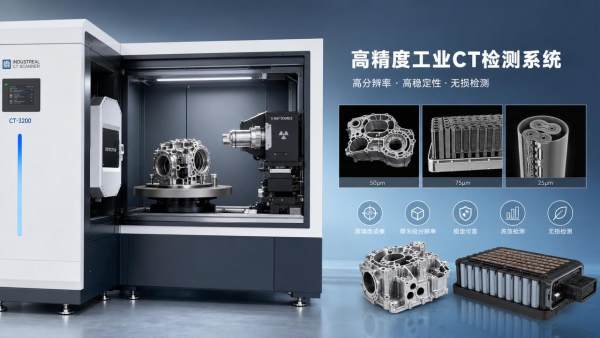
The first driver is product complexity. Voids, cracks, porosity, internal assembly errors, fiber orientation issues, and hidden dimensional deviations cannot be addressed with traditional surface inspection alone. Buyers increasingly need volumetric inspection that supports both defect analysis and dimensional metrology.
The second driver is speed pressure. Production lines and NPI teams want non-destructive insight without sending parts to multiple labs or waiting for destructive sectioning. Faster reconstruction, automated defect recognition, and recipe-based scanning are therefore becoming strategic buying points in industrial ct scanner wholesale discussions.
The third driver is digital integration. A scanner that produces good images but cannot export data cleanly into quality platforms creates an operational bottleneck. Procurement now has to ask whether the system supports data traceability, reporting automation, version control, remote collaboration, and secure integration with existing factory software.
The fourth driver is compliance and customer scrutiny. In regulated or high-consequence sectors, calibration traceability, validation documentation, access control, and reproducible inspection workflows matter as much as raw imaging capability. This is especially relevant for multinational manufacturers that need standardization across sites.
Beyond unit price: the cost areas procurement teams now watch closely
In industrial ct scanner wholesale, hidden cost categories often determine whether a purchase creates value or friction. Procurement teams should compare the following areas in a structured way rather than treating them as secondary details.
1. Installation and site readiness
Power requirements, radiation shielding, vibration conditions, environmental control, and floor space can add substantial project cost. A low unit price may lose its advantage if site adaptation is extensive or poorly defined in advance.
2. Software licensing and upgrade model
Many industrial ct scanner wholesale offers look competitive until software modules are added. Reconstruction packages, metrology functions, defect analysis tools, AI-assisted segmentation, CAD comparison, and multi-user licensing can materially affect the real budget.
3. Maintenance, uptime, and consumables
X-ray tube life, detector stability, preventive maintenance intervals, service engineer availability, spare part lead times, and calibration support shape operating continuity. For high-throughput plants, downtime can outweigh any initial savings.
4. Training and workflow maturity
A scanner that requires highly specialized operators increases dependency risk. Buyers should assess whether the supplier can provide role-based training for operators, quality engineers, and metrology specialists, plus documentation that supports standardized use across shifts and sites.
5. Future application flexibility
Procurement teams should ask whether the machine can handle denser materials, larger parts, higher resolution needs, or more automated workflows in the future. Industrial ct scanner wholesale decisions increasingly need to support evolving product portfolios, not just current parts.
How these changes affect different stakeholders
The shift in industrial ct scanner wholesale priorities affects more than procurement. The scanner now sits at the intersection of quality, engineering, operations, compliance, and digital transformation. This means supplier evaluation must involve multiple internal stakeholders early in the process.
The technical signals worth watching before you shortlist suppliers
In industrial ct scanner wholesale, technical review should center on real application outcomes rather than generic specification claims. Procurement teams should request evidence from sample parts that resemble their own use cases in material, size, density, and defect type.
Key signals include reconstruction quality under challenging geometries, dimensional measurement reliability, scan cycle consistency, and software usability for non-expert operators. It is also important to check how the system handles common artifacts, including beam hardening, scatter, ring artifacts, and motion-related errors. A system that performs well in a polished demo but poorly under actual factory conditions is a frequent source of post-purchase disappointment.
Another important signal is scalability. Can the supplier support offline programming, robotic loading, batch scanning, or AI-based defect classification later? Industrial ct scanner wholesale is increasingly tied to smart manufacturing goals, so the machine should not become a closed island within two years.
Why after-sales capability is becoming a strategic buying factor
One of the strongest changes in industrial ct scanner wholesale is the increased weight given to after-sales support. For procurement teams, service is no longer a soft consideration. It is a measurable risk-control factor. Remote diagnostics, preventive maintenance planning, parts availability, software support, application engineering, and response-time commitments directly affect operational continuity.
This is especially important for global manufacturers with plants in different regions. A supplier with weak local support may delay validation, increase internal troubleshooting burden, and create inconsistent inspection outcomes from site to site. Buyers should therefore assess service infrastructure with the same rigor applied to detector resolution or tube power.
A practical decision framework for industrial ct scanner wholesale evaluation
To respond to current market changes, procurement teams can use a staged evaluation model. This helps prevent overbuying, underbuying, or selecting a scanner that fits a brochure better than a production environment.
What procurement teams should do next
The next step in industrial ct scanner wholesale planning is not to request more quotes blindly. It is to sharpen the evaluation model. Procurement should align with quality, engineering, and operations on what business problem the scanner must solve first: production release, incoming inspection, failure analysis, dimensional metrology, or process development. Once that is clear, supplier comparisons become more objective and less vulnerable to marketing noise.
It is also wise to ask suppliers questions that reveal execution maturity: How quickly can they support sample validation? What application references do they have in similar materials and part sizes? How are software updates managed? What uptime commitments can they contractually support? How do they train new users after initial commissioning? These questions often expose the real difference between a low-price offer and a high-value industrial ct scanner wholesale partnership.
Final judgment: value comes from fit, stability, and support
The most important change in industrial ct scanner wholesale is simple: buyers are no longer rewarded for choosing the lowest unit price alone. They are rewarded for choosing systems that fit the application, sustain measurement confidence, integrate with modern quality workflows, and remain supportable over time. In a manufacturing environment shaped by precision, compliance, and faster iteration cycles, those factors define real purchasing success.
If your organization wants to judge how these trends affect its own sourcing strategy, focus on five questions: Which inspection risks are becoming more expensive? Which applications require volumetric insight instead of surface checks? What software and traceability expectations are increasing? How much downtime can operations tolerate? And which supplier can support not just the first installation, but the next stage of inspection maturity as well?
Recommended News
 May 05, 2026Industrial CT Scanner Wholesale: What Matters Beyond Unit PriceIndustrial CT scanner wholesale buyers should look beyond unit price. Compare TCO, resolution, uptime, software, compliance, and support to secure stronger ROI and lower risk.
 May 04, 2026How to Compare a Semiconductor Metrology Equipment Supplier Without Missing Critical SpecsSemiconductor Metrology Equipment Supplier comparison guide: learn how to verify critical specs, validate real-world performance, and choose a supplier that fits your process, data, and compliance needs.
 Apr 24, 20263D Scanning for Quality Control: Where Errors Begin3D Scanning for quality control starts with setup, calibration, and alignment. Learn how NIST Standards for calibration and advanced metrology solutions improve repeatable inspection.
 Apr 24, 2026Coordinate Measuring Machines or CT Metrology for Hidden Features3D Scanning and Coordinate Measuring Machines vs CT metrology: learn how hidden-feature inspection, industrial sensors, and NIST standards impact accuracy, speed, and smarter QA decisions.